
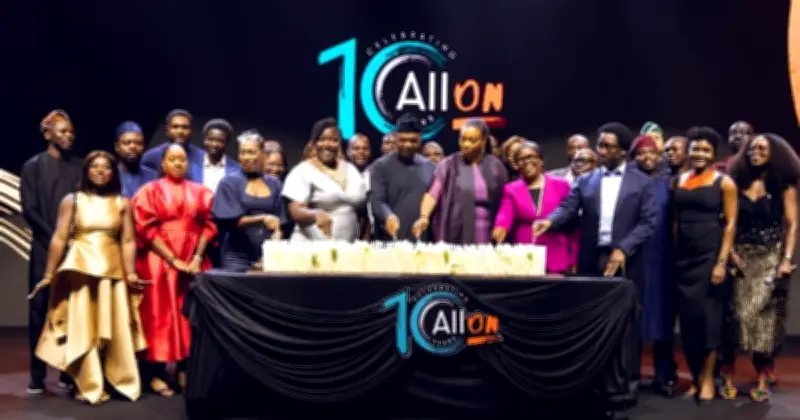
All On Partnerships for Energy Access hosted its 10th Anniversary Dinner and Fireside Chat in Lagos, bringing together leaders from government, development finance institutions, the private sector, development organisations, academia, and the renewable energy industry. The event celebrated a decade of catalytic investment while setting the agenda for the future of energy access in Nigeria.
A Decade of Building Businesses and Expanding Energy Access
The evening reflected ten years of building businesses, strengthening markets, and expanding access to clean, reliable, and affordable energy through collaboration. It looked ahead by bringing together influential voices to explore how partnerships, innovation, and long-term investment can accelerate universal energy access for millions more Nigerians.
Representing Lagos State Governor Babajide Olusola Sanwo-Olu, the Honourable Commissioner for Energy and Mineral Resources, Hon. Biodun Ogunleye, congratulated All On on its ten-year journey. He described the organisation as an important contributor to Nigeria's renewable energy ecosystem and commended All On for demonstrating that underserved communities are not beyond the reach of sustainable investment. He reaffirmed Lagos State's commitment to creating an enabling policy environment that encourages innovation, investment, and private sector participation in the electricity market.
CEO Reflects on Evolution from Vision to Impact Investor
Caroline Eboumbou, Chief Executive Officer of All On, welcomed guests and reflected on the organisation’s evolution from an ambitious vision into one of Nigeria's leading impact investors and ecosystem builders. She acknowledged the presence of founding visionary and former Board Chairman Dr. Osagie Okunbor, the Board of Directors, investees, partners, government institutions, and communities whose collective efforts helped shape All On's first decade.
Eboumbou noted that while capital was essential, experience had shown that expanding energy access required far more than financing businesses alone. "We realised very quickly that we needed to be more than just an investor. Building this market required us to combine catalytic capital with technical assistance, venture support, ecosystem development and strategic partnerships. That is how lasting impact is created," she said.
Today, All On's work has contributed to reaching nearly two million lives, demonstrating what is possible when patient capital is combined with innovation, entrepreneurship, and long-term collaboration across the renewable energy ecosystem.
Fireside Chat with UN Representative Highlights Partnerships
One of the evening's defining moments was a fireside conversation between Eboumbou and Damilola Ogunbiyi, Chief Executive Officer and Special Representative of the United Nations Secretary-General for Sustainable Energy for All (SEforALL). Their discussion explored the evolution of Nigeria's off-grid energy sector over the past decade and the partnerships required to deliver universal energy access across Africa.
Drawing on years of collaboration with All On, Ogunbiyi reflected on the organisation’s role in helping shape Nigeria's renewable energy market, highlighting the importance of institutions that build markets, strengthen businesses, and mobilise investment rather than simply financing individual projects. Both leaders agreed that while significant progress has been made, the next decade will require even stronger partnerships, continued innovation, and sustained investment to ensure that millions more Africans gain access to reliable, affordable, and sustainable energy.
Impact Showcase and Independent Evaluation
The conversation was followed by an Impact Showcase, where Dalberg presented findings from its independent evaluation of All On's first decade of work. The assessment highlighted the organisation’s contribution to expanding energy access through catalytic investment, venture building, enabling finance, and ecosystem development, while demonstrating measurable improvements in business growth, market development, and opportunities for underserved communities. The showcase reinforced the impact of an integrated approach that combines investment with long-term market building.
Looking Ahead: The Future of Nigeria's Renewable Energy Sector
A second fireside discussion shifted the focus from reflection to the future of Nigeria's renewable energy sector. Moderated by Abiodun Oni, Chief Executive Officer of FundCo, the panel featured Sandra Dozie, Chief Executive Officer of Salpha Energy, and Muhammad Wakil, Country Delivery Lead (Nigeria) for the Global Energy Alliance for People and Planet (GEAPP). Together, they explored the opportunities and challenges shaping the next phase of Nigeria's energy transition, highlighting local manufacturing, innovative financing, enabling policy, private sector investment, and strategic collaboration as critical drivers of future growth.
Special Recognition for Key Partners
The evening also featured a Special Recognition segment celebrating the collaborations that have shaped All On's first decade. Awards of Excellence were presented to organisations and individuals whose vision, leadership, and collaboration have helped strengthen Nigeria's renewable energy ecosystem, from pioneering ecosystem development and policy advocacy to advancing innovation, market growth, and universal energy access. Honourees included The Rockefeller Foundation, Nigeria Climate Innovation Centre (NCIC), Sustainable Energy for All (SEforALL), the Rural Electrification Agency (REA), the Renewable Energy Association of Nigeria (REAN), Shell Nigeria, and Dr. Osagie Okunbor, Founding Chairman of the All On Board of Directors.
Commitment to Scaling Impact in the Next Decade
Closing the evening, All On reaffirmed its commitment to building on the momentum of its first decade. As the organisation looks towards the future, its focus remains on mobilising catalytic capital, strengthening businesses, fostering innovation, and deepening partnerships that will accelerate access to clean, reliable, and affordable energy for millions more Nigerians. The first decade demonstrated what is possible. The next decade will be about scaling that impact.




