
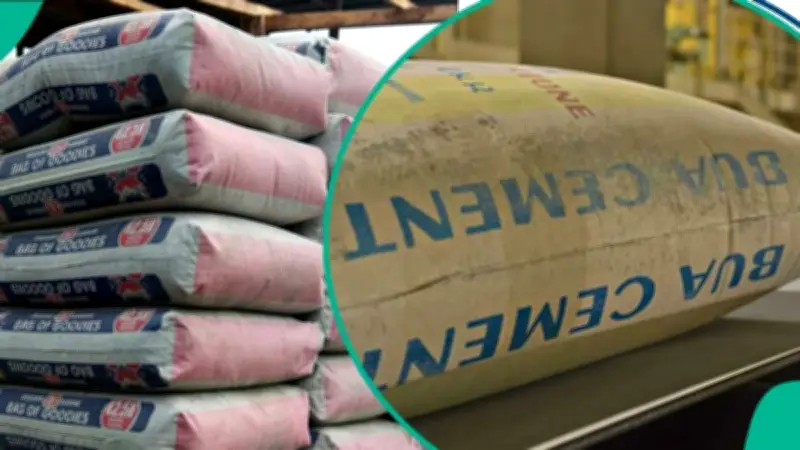
Despite producing more cement than it consumes, Nigeria remains one of the most expensive places in Africa to buy the essential building material, raising fresh concerns over housing affordability and infrastructure costs. The country's cement industry, dominated by Dangote Cement, BUA Cement, and HBM Nigeria Plc (formerly Lafarge Africa), has an installed production capacity of about 60 to 65 million metric tonnes annually. With new factories under construction, national capacity is expected to rise to nearly 85 million tonnes in the coming years. Yet, domestic demand is estimated at just 25 to 30 million tonnes annually, leaving a sizeable surplus that is exported to neighbouring countries.
Dealers Release New Cement Prices
Market checks show that cement prices have eased slightly in some locations compared to the peak levels above ₦13,000 recorded in parts of the country earlier this year. Dealers now sell a 50kg bag of Dangote, BUA, and HBM cement at varying prices depending on location, transportation costs, and distributor margins, although prices remain significantly higher than in many African markets. The persistently high prices have continued to frustrate home builders, contractors, and developers despite Nigeria's abundant production capacity.
Nigeria Tops Africa's Cement Price Chart
Industry comparisons reveal that Nigerians pay considerably more for cement than consumers in several African countries. According to a report by The Guardian, in South Africa, a 50kg bag sells for the equivalent of about ₦6,000 to ₦7,000, while prices in Egypt, one of the world's largest cement producers, range between ₦4,000 and ₦5,000 due to lower production costs and excess capacity. Kenyan consumers typically pay between ₦6,500 and ₦7,500 per bag, while prices in Ghana average ₦7,000 to ₦8,000. The disparity has intensified calls for measures that will make locally produced cement more affordable.
Why Cement Remains Expensive
Manufacturers insist that producing cement in Nigeria is far from cheap. Although limestone and other major raw materials are sourced locally, companies still import machinery, spare parts, packaging materials, and industrial additives. The depreciation of the naira has sharply increased these costs. They also point to rising energy prices following fuel subsidy removal, noting that cement production depends heavily on gas, coal, diesel, and alternative fuels. Logistics present another major challenge. With many cement plants located far from major consumption centres, transportation alone accounts for an estimated 30 to 40 per cent of the final retail price. Manufacturers further cite inflation, financing costs, maintenance expenses, and strong demand from housing and infrastructure projects as factors keeping prices elevated.
FG Pushes for Price Reduction
The soaring cost of cement has also become a concern for the Federal Government. Minister of Works David Umahi recently urged cement manufacturers to reduce prices, warning that rising costs are making road and infrastructure projects increasingly expensive and forcing the government to revise contract values. Umahi disclosed that formal engagements with cement producers began on July 1, 2026, intending to secure more affordable prices for both public infrastructure and private housing projects.
Experts Demand More Competition
Stakeholders argue that Nigeria's housing deficit of over 16 million units cannot be addressed unless cement becomes more affordable. President of the Real Estate Developers Association of Nigeria (REDAN), Oba Akintoye Adeoye, described high cement prices as one of the biggest obstacles to affordable housing delivery. Executive Director of the Housing Development Advocacy Network (HDAN), Festus Adebayo, urged the Federal Government to introduce policies that lower production costs through improved gas supply, stable electricity, concessionary energy support, and duty waivers on essential manufacturing equipment. Estate surveyor and valuer Sola Enitan said Nigeria's cement industry has become "a technical success but a social laggard." He called for stronger oversight by the Federal Competition and Consumer Protection Commission (FCCPC), improved rail links to cement plants, greater market transparency, and policies that encourage new manufacturers to enter the industry. According to industry experts, expanding competition, improving transport infrastructure, stabilising energy costs, and strengthening the naira could ultimately bring cement prices closer to levels seen elsewhere in Africa, easing the burden on millions of Nigerians seeking to build homes and businesses.




