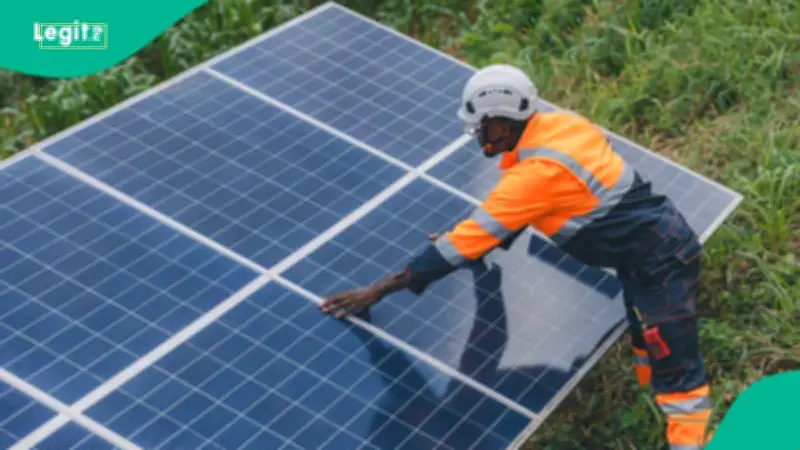
Nigeria has emerged as a notable exporter of solar panels, generating N85.79 billion in revenue during the first quarter of 2026, with the United States leading the list of buyers. This development underscores the country's growing role in Africa's renewable energy market, driven by increased government support for local manufacturing.
Export Destinations and Values
According to the National Bureau of Statistics (NBS) Foreign Trade Report for Q1 2026, solar panels classified as 'photovoltaic cells assembled in modules or made up into panels' were shipped to several countries. The United States imported the highest value, N34.23 billion, followed by Burkina Faso with N20.40 billion. India purchased N13.85 billion worth, Indonesia N12.71 billion, and Ghana N2.96 billion.
This export performance comes despite Nigeria importing N435.52 billion worth of solar panels in 2025, highlighting a shift toward domestic production and export capability.
Government Investments Driving Growth
Industry stakeholders attribute the export surge to government initiatives, particularly through the Rural Electrification Agency (REA). A key factor is the $300 million Distributed Access through Renewable Energy Scale-up (DARES) programme, funded by the World Bank. This initiative partners with financial institutions like FCMB, Lotus Bank, and InfraCorp to provide grants, affordable financing, and offtake arrangements for companies in Nigeria's renewable energy value chain.
In addition, the REA recently announced plans to invest approximately $425 million in establishing eight new renewable energy manufacturing facilities. This follows a significant increase in solar panel production capacity, which has grown from 120 megawatts two years ago to 300 megawatts.
Nigeria's Emerging Role as Regional Hub
Speaking during a webinar organized by the African Association of Energy Journalists and Publishers (AJERAP), REA Managing Director Abba Aliyu described the progress as a result of President Bola Ahmed Tinubu's Nigeria First policy. Aliyu noted that imports of solar cells and components for local assembly reached 837MW in 2025, more than double the combined 375MW imported in all previous years. He emphasized that component imports now exceed imports of finished solar products, indicating growing local manufacturing capacity.
Aliyu added that the $425 million investment, supported by commitments from the Nigeria Renewable Energy Innovation Forum (NREIF) 2025, is building a complete ecosystem covering manufacturing, financing, and deployment of renewable energy technologies. He revealed that solar panels manufactured in Nigeria are already being exported from Lagos to Accra, Ghana, positioning the country as an emerging supplier of renewable energy solutions across the region.
'We are transitioning from a renewable energy consumer to a regional supplier,' Aliyu said, adding that solar projects in border communities could support future cross-border electricity trade. He further disclosed that several African countries, including Mozambique, Benin Republic, Burkina Faso, Niger, Chad, Mauritania, and Mauritius, are seeking guidance from the REA as they pursue similar renewable energy development strategies.
Additional Government Initiatives
In a related development, the Federal Executive Council (FEC) approved N68.7 billion for key electricity projects in universities and teaching hospitals across Nigeria. Authorities stated that these projects reflect the government's commitment to ensuring a steady electricity supply in vital sectors such as education and healthcare. The university project involves engineering, procurement, and construction under the Energising Education Programme, led by the REA.