
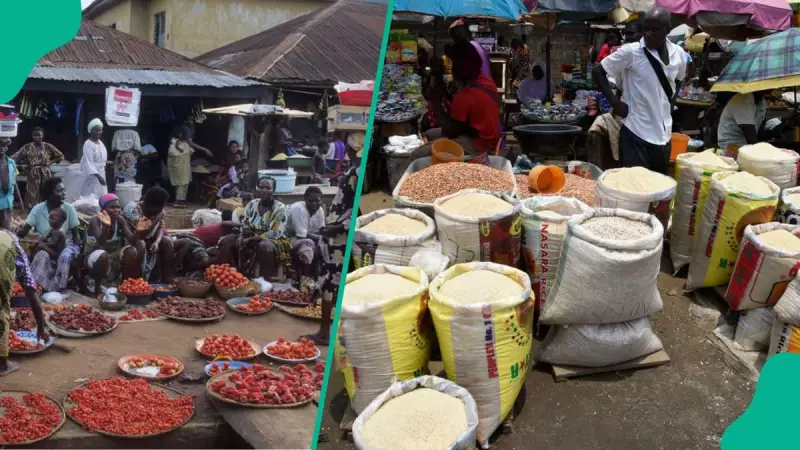
Residents of Nigeria's Federal Capital Territory are experiencing a welcome respite as the cost of essential food items has dropped significantly across major markets in Abuja. This follows the conclusion of the festive season, according to a recent market survey conducted by the News Agency of Nigeria (NAN).
Market Survey Reveals Notable Price Reductions
The survey, carried out between November 2025 and January 2026, documented substantial price cuts for several staples. At the popular Garki Model Market, a dustbin basket of big red tomatoes now sells for between N5,000 and N5,500, down from its previous range of N6,000 to N7,000. Similarly, the price of shombo pepper fell to around N3,000 from N4,500-N5,000.
This trend was echoed in other major markets including Nyanya, Gwagwalada, Apo Resettlement, Dei-Dei, Karu, Lugbe, and Mararaba. In Nyanya Market, a basket of tomatoes was reported to sell for as low as N2,000 to N3,000, a sharp drop from the N4,000 seen during the peak festive period. Onions, yams, beans, and poultry also recorded notable declines.
Official Data Confirms Inflation Slowdown
The market observations align with the latest official figures from the National Bureau of Statistics (NBS). The NBS reported that Nigeria's food inflation rate on a month-on-month basis declined to -0.36 per cent in December 2025, down from 1.13 per cent in the previous month.
The statistics bureau attributed this negative inflation rate to lower average prices of key items such as tomatoes, garri, eggs, potatoes, millet, vegetables, beans, onions, and peppers. However, the survey noted that some items like beans and frozen fish showed little change in certain markets, and prices in Wuse Market remained comparatively higher.
Experts Warn of Temporary Relief
While consumers welcome the lower prices, traders, farmers, and economic experts have cautioned that this decline may be short-lived. Traders attributed the drop to reduced consumer spending in January and increased supply from ongoing harvests.
Kabir Ibrahim, the National President of the All Farmers Association of Nigeria (AFAN), stated that the price drop is largely seasonal. He warned that food costs could rise again without sustained government policies to address fundamental challenges like insecurity, foreign exchange volatility, high transportation costs, and support for dry-season farming.
Residents who spoke to NAN also expressed concern that the relief is undermined by broader economic issues. Cyril Okocha, a businessman, highlighted that food affordability remains critically tied to income levels, pointing out that salaries have not kept pace with inflation and minimum wage implementation remains inconsistent across states.
The NBS list of states with the highest food inflation rates for the period includes Yobe, Ogun, Abuja, Lagos, Delta, Kano, Kogi, Osun, Rivers, and Ekiti, indicating that price pressures remain significant in many parts of the country.




