
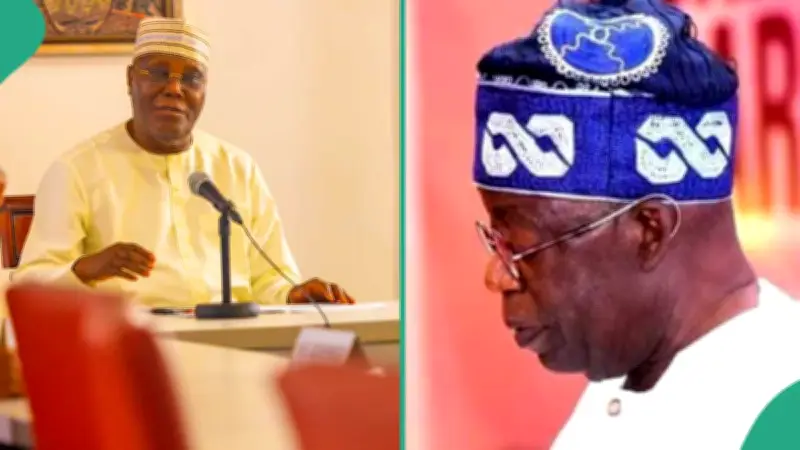
Former Vice President Atiku Abubakar has sharply criticized the Presidency's celebration of Nigeria's GDP growth, arguing that such macroeconomic indicators are meaningless to ordinary citizens struggling with soaring costs of food, transport, and education. In a statement responding to the Federal Government's repeated promotion of economic gains following the exchange-rate adjustment, Atiku described the celebration as 'dangerously out of touch' with the realities on the ground.
Atiku Questions Economic Impact on Nigerians
Atiku, who is the African Democratic Congress (ADC) 2027 presidential candidate, posed a series of rhetorical questions to underscore his point: 'Has the purchasing power of the average Nigerian increased? Can civil servants buy more food today than they could three years ago? Are transport fares lower? Are manufacturers paying less for energy? Have small businesses become more profitable?' He answered, 'The answer, tragically, is no.'
His remarks come amid a backdrop of rising inflation and widespread hardship, with many Nigerians feeling the pinch of economic reforms. The former vice president's critique highlights a growing disconnect between the government's optimistic outlook and the lived experiences of citizens.
IMF Data Contradicts Government Claims
Atiku pointed to the International Monetary Fund (IMF), which the Presidency has often cited to justify its reform agenda, noting that the IMF itself has cautioned that life remains hard for most Nigerians. He cited IMF estimates showing that 63% of Nigerians now live below the national poverty line, and that approximately 27 million Nigerians faced food insecurity in late 2025. 'Those are not opposition figures,' Atiku emphasized. 'They are the findings of the same institution the government celebrates whenever it commends aspects of its reforms.'
These statistics paint a grim picture, challenging the narrative of economic progress. Atiku argued that economic policy should be judged by tangible improvements in citizens' living standards, not by data points that fail to reflect household realities.
Government's Own Plans Undermine Its Case
Atiku also drew attention to the Federal Government's recent announcement that it intends to begin measuring poverty, household income, and inequality to demonstrate that its reforms are benefiting ordinary people. He said this move amounts to a concession that GDP figures on their own are insufficient. By acknowledging the need for additional metrics, the government implicitly admits that current indicators do not capture the full picture.
This development further strengthens Atiku's argument that the celebration of GDP growth is premature and misleading. He called for a more holistic approach to evaluating economic performance, one that prioritizes the welfare of the average Nigerian.
Political Context and 2027 Ambitions
Atiku has been at the forefront of calls for the removal of President Bola Tinubu and the ruling All Progressives Congress (APC) in the 2027 general election, following his defeat in the 2023 presidential election. Atiku contested under the Peoples Democratic Party (PDP) but lost to Tinubu. To actualize his presidential ambition, he later dumped the PDP and led a coalition that adopted the ADC, emerging as its 2027 candidate.
Atiku's Camp Rejects Tinubu's Defense of INEC
In related news, ADC chieftain Kenneth Okonkwo criticized President Tinubu for defending the Independent National Electoral Commission (INEC) over bias allegations, saying the electoral body had not earned public confidence. Okonkwo, who speaks for Atiku ahead of 2027, cited concerns over security and governance as reasons Tinubu may struggle to win re-election. The ADC spokesperson also accused the ruling APC of attempting to weaken opposition parties and undermine Nigeria's democratic process before 2027.




