
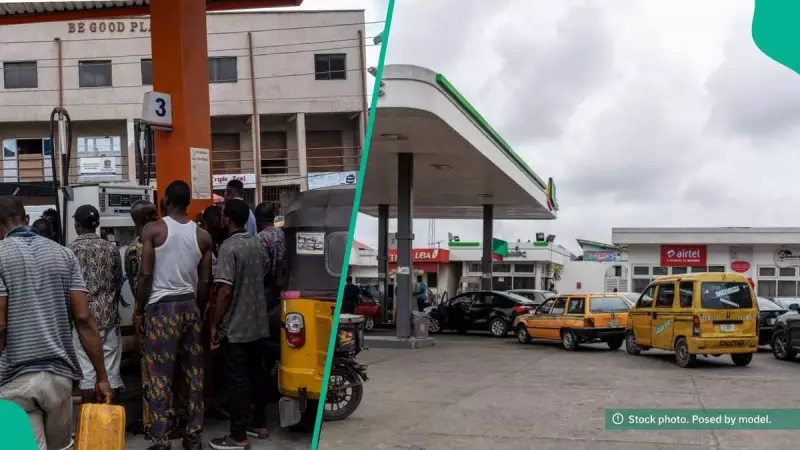
The Central Bank of Nigeria (CBN) has delivered a sobering economic forecast, projecting that the price of Premium Motor Spirit (PMS), commonly known as petrol, could average around N950 per litre in the year 2026. This prediction comes even as Nigerians currently enjoy lower prices triggered by the operational entry of the Dangote Petroleum Refinery.
Current Relief Versus Future Projections
The bank's outlook, detailed in its 2026 Nigerian economic forecast, presents a contrast to the present situation. In December 2025, the Dangote Refinery initiated a price war by slashing its gantry price to N699 per litre, down from the prevailing rate of over N900. Subsequently, through its retail partner MRS Oil, it set a pump price of N739 per litre.
This aggressive move forced other major marketers, including the Nigerian National Petroleum Company Limited (NNPCL), to reduce their prices to below N800 per litre in a bid to retain customers. The CBN's warning suggests this period of relief may be temporary, with costs poised to climb again.
The Key Factors Behind the N950 Forecast
The CBN's analysis is built on a confluence of domestic and international economic indicators. The bank's model assumes that the global price of crude oil will reach $60 per barrel by the end of 2025 before moderating to approximately $55 per barrel in 2026.
Concurrently, the bank anticipates a period of relative stability in the foreign exchange market, with the Naira trading around N1,400 to the US Dollar in 2026. While improved FX stability, foreign investment inflows, and stronger economic activity are expected to ease some pressure, they will not be enough to prevent the projected increase.
A cornerstone of the CBN's argument is Nigeria's continued dependence on imported petrol. The bank issued a stark warning that a return to full-scale fuel imports could trigger a sharp and immediate spike in pump prices nationwide. It emphasised that sustained local refining capacity is the critical buffer against such volatility.
Domestic Production and Global Trends
The forecast also hinges on Nigeria's crude oil output. The CBN expects the nation to maintain a daily production level of about 1.5 million barrels throughout 2026. This output is deemed vital for providing feedstock for domestic refineries and stabilising local fuel prices.
On a broader scale, the CBN noted that global energy prices are projected to decline by roughly 6.99% in 2026, primarily driven by the anticipated dip in crude oil costs. However, this global trend may not translate directly to lower prices at Nigerian pumps due to structural and logistical factors within the country's energy supply chain.
The CBN's report serves as a crucial reminder of the fragile nature of Nigeria's fuel pricing ecosystem. While the Dangote Refinery has introduced welcome competition and lower prices in the short term, long-term price stability remains inextricably linked to global oil markets, exchange rate performance, and most importantly, the nation's ability to achieve self-sufficiency in refining.




