
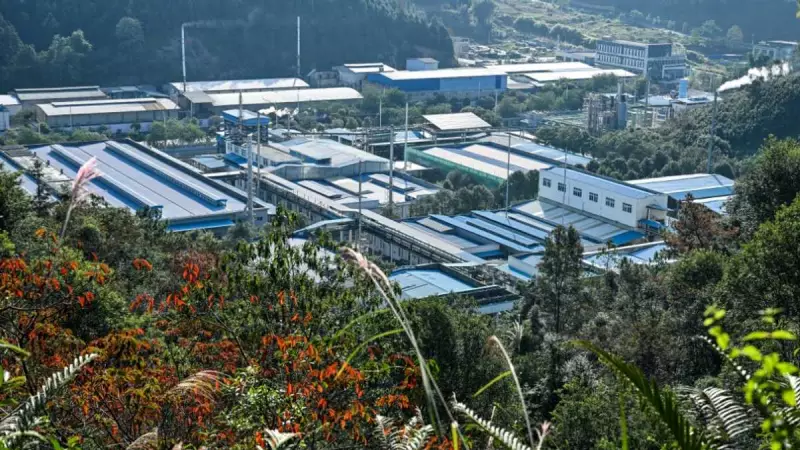
Deep within the reddish earth of southern China lies a source of immense global power. One of the world's largest concentrations of vital rare earth elements is extracted around the clock by a heavily guarded and secretive industry, cementing Beijing's strategic advantage.
The Heart of China's Rare Earth Empire
The lush hills of Jiangxi province form the core of this operation, hosting the majority of the country's rare earth mines. These materials are indispensable for manufacturing a vast array of modern products, from everyday smartphones to advanced missile guidance systems.
The industry operates under a veil of secrecy, tightly controlled by Chinese authorities who rarely permit media access. During an unusual visit to the region last month, journalists from AFP were closely followed and monitored by unidentified minders. Requests for interviews with companies were uniformly declined.
This protection shields a sector experiencing explosive growth. The United States Geological Survey (USGS) observed a dramatic increase in rare earth processing sites, from just 117 in 2010 to 2,057 by 2017. Today, most of the 3,085 sites recorded nationwide are concentrated in Jiangxi's rugged terrain.
24/7 Operations and Global Repercussions
Local residents confirm the relentless pace of activity. One mine near the town of Banshi operates continuously. "It's busy 24 hours a day, seven days a week," a local stated. The area is further expanding, with construction underway on a massive new industrial park dedicated to processing these critical minerals.
This bustling hub is no accident but the result of a decades-long strategic push by Beijing. The payoff was evident this year when a tentative truce in the trade war with the United States was reached, partly contingent on China easing its strict rare earth export controls.
This dependency has triggered alarm in Western capitals. The European Union recently announced nearly three billion euros in funding to develop its own mining, refining, and recycling projects, aiming to reduce reliance on China. Meanwhile, Washington is scrambling to build alternative supply chains, though experts caution this will take many years.
Heavy vs. Light: The Specialization of Power
China's rare earth industry is dominated by two key hubs. The Bayan Obo district in Inner Mongolia is rich in "light" rare earths used for magnets in consumer electronics. However, the hills surrounding Ganzhou city in Jiangxi specialize in far more valuable "heavy" rare earths.
These elements, like dysprosium and terbium, are harder to extract but crucial for high-tech defense and energy applications, including fighter jet engines, precision-guided missiles, and advanced lasers. The Longnan district alone hosts 886 processing locations, accounting for 31.5% of Jiangxi's total.
Mining practices have evolved from highly destructive "moving mountains" techniques, which stripped away vegetation and topsoil. A government crackdown on "chaotic extraction" has consolidated the industry into two major state-owned giants. While large signs now warn against illegal mining, the landscape still bears scars of past exploitation, with patches of bare red soil where vegetation struggles to return.
As one worker on Ganzhou's "Rare Earth Avenue" labored on the new headquarters for the China Rare Earth Group, the message was clear: China's control over these critical resources remains a formidable lever of global economic and strategic influence.




