
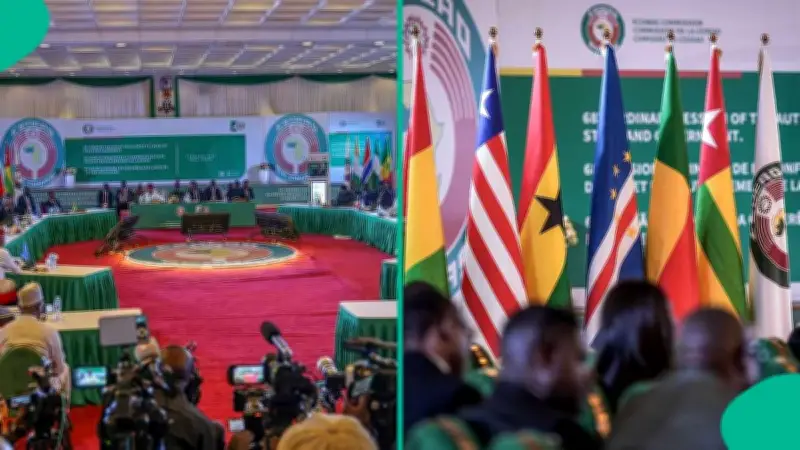
The Economic Community of West African States (ECOWAS) has renewed its commitment to launching the ECO, a long-anticipated single regional currency, by the year 2027. This initiative is positioned as a central mechanism for deepening economic integration across West Africa. The announcement was made during the 69th Ordinary Session of the ECOWAS Authority of Heads of State and Government, held on Sunday in Lungi, Sierra Leone, under the chairmanship of Sierra Leonean President Julius Maada Bio. A final communiqué detailing the outcomes was issued on Tuesday after the summit concluded.
ECO Currency and Regional Economic Outlook
In the communiqué, the Authority stated that the ECO would serve as "a key instrument for deepening regional economic integration and promoting sustainable, inclusive and resilient growth within the Community." Member states that meet the agreed convergence criteria will adopt the currency first, while those not yet qualifying will receive support to join at a later date. The bloc also welcomed the registration of the name "ECO" with the African Intellectual Property Organisation and directed its Commission to pursue trademark registration with other regional and international intellectual property bodies.
On the broader economic picture, leaders projected a positive regional outlook for 2026, citing falling inflation, lower public debt-to-GDP ratios, and a growing current account surplus. However, fiscal deficits were flagged as an ongoing concern that requires continued attention.
Security, Xenophobia, and Regional Diplomacy
The summit addressed rising insecurity across the Sahel and Lake Chad Basin. It endorsed a revised roadmap to activate the ECOWAS Counterterrorism Brigade, with full operational capacity expected by July 2027. The communiqué specifically condemned "the increasing spate of banditry, kidnappings and abductions of school children, particularly in Northern Nigeria," and expressed solidarity with Nigeria while commending President Bola Tinubu "for the swift actions taken to secure the release of victims."
ECOWAS strongly condemned continued xenophobic attacks on West Africans in South Africa, calling on South African authorities to protect foreign nationals and resolve the issue permanently. The bloc backed Ghana's proposal to bring the matter before the African Union Assembly. Vice-President Kashim Shettima of Nigeria challenged South Africa to remember who funded its freedom, telling ECOWAS leaders that Nigerian students had money taken from their scholarship allowances to bankroll anti-apartheid liberation movements across Southern Africa. Shettima made these remarks on Monday, July 20, while addressing the session, where he pushed for a united West African response to xenophobic violence targeting African migrants in South Africa.
Trade, Infrastructure, and New Leadership
Leaders warned that individual member states signing bilateral trade deals outside the bloc risk undermining the ECOWAS Customs Union. They directed the Commission to coordinate common positions in international trade talks. The summit also welcomed the Inter-Governmental Agreement on the African Atlantic Gas Pipeline, describing it as a strategic boost to regional energy security.
On leadership, the summit appointed General Birame Diop of Senegal as President of the ECOWAS Commission for the 2026 to 2030 term, and elected Senegalese President Bassirou Diomaye Faye as the new Chairman of the ECOWAS Authority for a one-year term. Leaders also thanked China for constructing and donating the new ECOWAS headquarters in Abuja.
On relations with the Alliance of Sahel States, covering Burkina Faso, Mali, and Niger, the mandate of Chief Negotiator Dr. Lansana Kouyaté was extended to December 2026, with leaders insisting that any negotiations must proceed as a unified bloc.




