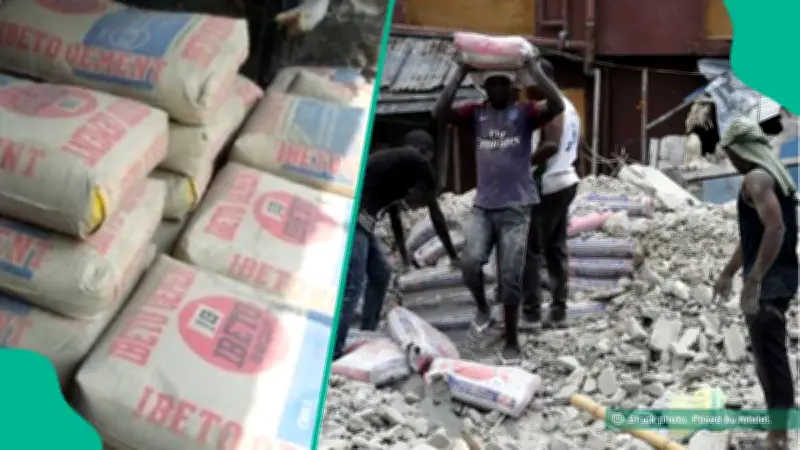
The Federal Competition and Consumer Protection Commission (FCCPC) has raised serious concerns over the rising cost of cement in Nigeria, stating that preliminary findings from a three-month investigation suggest market conditions alone may not explain the prices consumers are paying. The commission, in a statement on Tuesday, August 18, through its Director of Corporate Affairs, Ondaje Ijagwu, compared Nigeria's cement market with those of Kenya, Tanzania, South Africa, Egypt, Morocco, Algeria, and Togo, examining factors such as limestone access, production capacity, population, and retail prices.
Nigeria's Cement Prices on the Rise
Nigeria has an estimated installed cement production capacity of between 60 million and 65 million metric tonnes per year, while actual domestic consumption sits at about 25 million to 30 million tonnes. The country is also a net exporter of cement to neighbouring nations. Despite that surplus capacity, prices have climbed sharply. In January, a 50kg bag of cement sold for between N9,300 and N9,700. By mid-year, that figure had risen to between N10,500 and N13,000, and in some parts of the country, prices reached N13,000 to N15,000 in July.
BusinessDay reports that the FCCPC said this trend raises a key question: why has Nigeria's large production base and ready access to local limestone not pushed domestic prices down?
How Nigeria Cement Prices Compare With Kenya and Tanzania
The commission's cross-border comparison showed that cement in several African countries costs considerably less than in Nigeria. In Kenya, which has a population of about 58.6 million and cement demand estimated at 9.3 million metric tonnes in 2025, a 50kg bag sold for around $5.40, the equivalent of N7,344. In Tanzania, with a population of roughly 66.3 million and similar demand figures, the same quantity sold for about $4.80, or N6,528. Even Togo, which has no limestone deposits of its own, recorded a price of about $6.75 per 50kg bag, equivalent to N9,180.
Cement producers in Nigeria have pointed to higher energy costs, naira depreciation, expensive imported machinery and spare parts, and logistics expenses as the main drivers of the price increases. The FCCPC said it is verifying those claims against actual production cost data and capacity utilisation figures.
The commission said: "Of particular concern to the Commission is that this level of production capacity has not resulted in the downward pressure on domestic prices that might ordinarily be expected in a competitive market with substantial excess capacity."
FCCPC Summons Cement Companies
The FCCPC has issued Notices of Commencement of Investigation and Summons to Produce to major players in the industry, requiring them to submit data on pricing methods, production volumes, capacity utilisation, exports, and commercial relationships. Punch reports that the probe will look at possible coordinated pricing, abuse of market power, restrictions on supply, and anti-competitive distribution practices.
Tunji Bello, executive vice chairman and chief executive of the FCCPC, said cement's role in Nigeria's economy makes the investigation essential. Bello clarified that the investigation is not designed to block companies from earning returns.
Earlier, Legit.ng reported that the federal government has urged cement manufacturers in the country to cut down the prices of cement. The government warned that the prevailing price of the commodity was impacting infrastructure projects and escalating demands for contract variations. According to him, pressure has mounted on his ministry to alter existing contracts based on the increasing costs of cement.