Nigeria’s ambition to become a trillion-dollar economy by 2030 is being undermined by a severe human capital crisis, according to a new analysis from Nairametrics. The report highlights that the country’s workforce lacks the necessary skills, health, and education to drive sustainable economic growth, casting doubt on the feasibility of the target.
Human Capital Index Reveals Stark Deficits
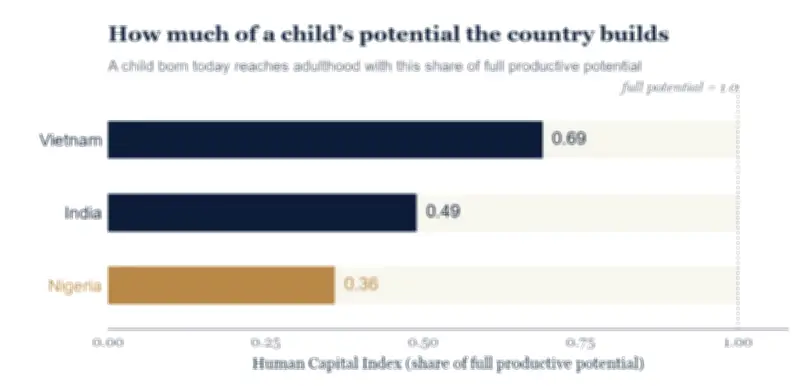
The World Bank’s Human Capital Index (HCI) ranks Nigeria 152nd out of 157 countries, indicating that a child born in Nigeria today will only achieve 36% of their potential productivity if they receive full education and health care. This places Nigeria among the bottom 10 nations globally, behind peers like Ghana (ranked 103rd) and Kenya (ranked 111th). The HCI measures the amount of human capital a child born today can expect to attain by age 18, considering survival, education, and health outcomes.
According to the report, Nigeria’s low HCI score translates to a significant drag on economic output. The World Bank estimates that the country loses approximately 1.5% of its annual GDP growth due to human capital gaps. This loss compounds over time, making it harder to achieve the ambitious trillion-dollar target set by the federal government.
Education System Under Strain
The education sector is a major contributor to the human capital deficit. Nigeria has the highest number of out-of-school children in the world, with an estimated 18.5 million children not receiving formal education, according to UNESCO data cited in the report. This accounts for about 20% of the global out-of-school population. The quality of education for those in school is also poor: only 30% of primary school students achieve minimum proficiency in reading and mathematics, as per the 2022 National Assessment of Learning Achievement in Basic Education.
Furthermore, the report notes that Nigeria’s tertiary education enrollment rate is just 12%, far below the sub-Saharan African average of 19%. This limits the pool of skilled workers needed for high-productivity sectors like technology, manufacturing, and services. The Nairametrics analysis argues that without a massive investment in education, the country cannot produce the human capital required to drive a trillion-dollar economy.
Healthcare Challenges Reduce Workforce Productivity
Health outcomes further compound the human capital problem. Nigeria has a maternal mortality rate of 512 deaths per 100,000 live births, one of the highest globally, and an under-five mortality rate of 117 per 1,000 live births, according to the World Health Organization. The report highlights that 35% of Nigerian children under five are stunted due to malnutrition, which impairs cognitive development and future earning potential.
These health challenges reduce the effective labor force. The World Bank estimates that Nigeria loses about 1.3% of its GDP annually to premature deaths and illness, a figure that could rise without intervention. The report also notes that the country spends only 3.9% of its GDP on healthcare, below the 5% recommended by the Abuja Declaration, and that out-of-pocket expenditure accounts for 70% of health spending, limiting access for the poor.
Economic Implications and Policy Recommendations
The human capital crisis has direct economic consequences. The Nairametrics report calculates that Nigeria’s GDP per capita could be 40% higher if the country achieved the average HCI score of low-income countries. This would add approximately $200 billion to the economy, making the trillion-dollar target more attainable. However, current trends suggest the gap is widening rather than narrowing.
To address the crisis, the report recommends increasing public spending on education to at least 15% of the federal budget, as recommended by UNESCO, and raising healthcare spending to 5% of GDP. It also calls for targeted interventions to reduce malnutrition, improve maternal and child health, and expand access to quality education, particularly in northern states where out-of-school rates are highest. The report concludes that without these investments, Nigeria’s trillion-dollar ambition will remain out of reach, as economic growth cannot be sustained on a foundation of weak human capital.