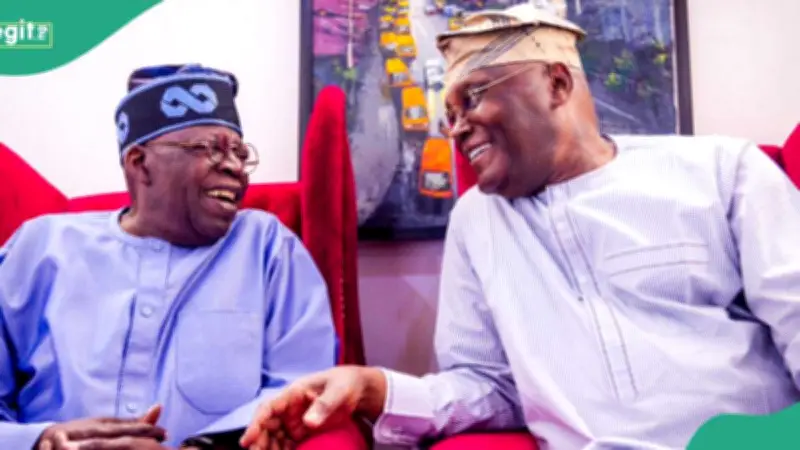
Former Vice President and African Democratic Congress (ADC) presidential candidate Atiku Abubakar has accused the Tinubu administration of spending nearly three years deepening Nigeria's electricity crisis before finally adopting a policy direction he first proposed more than two decades ago. In a statement dated Sunday, July 26, issued through his Senior Special Assistant on Public Communication, Phrank Shaibu, Atiku said the power minister's recent admission that Nigeria cannot rely solely on large, centralised power plants amounts to a long-overdue endorsement of decentralised electricity generation—a position he has consistently held since his tenure as Vice President.
Three Years of Worsening Crisis Before Policy Shift
Atiku argued that it should not take a government three years in office to recognise what was obvious over twenty years ago. He recalled that during President Olusegun Obasanjo's administration, he repeatedly pushed for a diversified electricity generation model incorporating hydroelectric, solar, gas and other energy sources. His conviction ran so deep that when Obasanjo named him chairman of the Power Sector Reform Committee—built around a gas-focused strategy—he refused to lead it. "Because I fundamentally disagreed with the policy direction, I declined to preside over the committee," Atiku said, adding that billions of dollars from federal, state and local governments were subsequently committed to that approach with little to show for it.
Tariff Hikes Before Structural Reforms
Atiku criticised the federal government for raising electricity tariffs before fixing the underlying problems in the sector. He stated that a responsible government would have addressed structural issues before asking citizens to pay more. "A government that thinks before it acts would have fixed the system before asking citizens to pay more," he said. The Tinubu administration did the opposite, increasing tariffs while Nigerians continued to experience widespread blackouts. Atiku noted that the National Assembly later investigated the reforms and held Obasanjo accountable, but he was never summoned because his refusal to chair the committee was already on record.
Consistency Over Two Decades
The former vice president emphasised that his support for decentralised power generation was not a recent position. He publicly restated it during an ARISE News interview in 2022 and made it a centrepiece of his presidential campaigns from 2007 through 2023. "For more than two decades, I have consistently argued that Nigeria's overdependence on a centralised generation system was economically unsustainable and technically inefficient," he said. Atiku described affordable and reliable electricity as the foundation of industrialisation, job creation and economic growth. He said the cost of the administration's slow learning curve had fallen squarely on Nigerian businesses and households paying more for less power.
ADC Government’s Energy Vision
Atiku said an ADC government under his leadership would pursue a diversified energy mix spanning hydro, gas and solar, while expanding transmission infrastructure, strengthening distribution networks and opening the sector to greater private investment. "Nigeria does not suffer from a shortage of ideas. It suffers from a shortage of leaders willing to act on the right ideas at the right time," he added.
Broader Economic Critique
In a related report, Atiku argued that Nigeria will never achieve prosperity through borrowing, importing goods or raising taxes. He asserted that the country's only path forward is to produce its own food, manufacture its own goods and build an export economy. The former vice president said the economic suffering many Nigerians now face is not simply a product of global conditions but the direct result of decades of policy choices that favoured consumption over production.