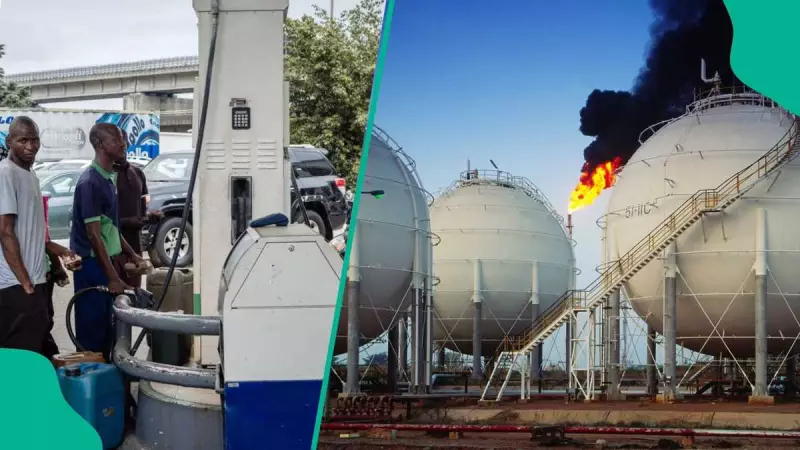
The cost of Premium Motor Spirit (PMS), commonly known as petrol, is witnessing a gradual uptick across Nigeria. This development follows the commencement of a planned maintenance and upgrade exercise at the Dangote Petroleum Refinery, a critical domestic supplier.
Scheduled Maintenance Triggers Price Adjustments
Edwin Devakumar, Vice President of the Dangote Group, confirmed that the refinery has started a scheduled turnaround maintenance on its primary gasoline-producing unit. This unit, known as the Residue Fluid Catalytic Cracker (RFCC), is essential for petrol production. According to reports, the maintenance work began during the week of December 6, 2025, and is projected to be completed by late January 2026.
Devakumar, in a statement to Platts (a unit of S&P Global Energy), also indicated that the refinery's Crude Distillation Unit (CDU) would be temporarily shut down for a few days in early January 2026. This brief pause in crude processing is part of the overall maintenance plan.
Immediate Impact on Fuel Pricing
The market has reacted swiftly to the news of the refinery's reduced operations. Checks by industry observers reveal that ex-depot prices—the cost at which depots sell to retailers—have risen significantly in some regions.
Data from the Major Energies Marketers Association of Nigeria (MEMAN) shows ex-depot prices in cities like Calabar, Warri, and Port Harcourt now range between N800 and N805 per litre. In Lagos, prices were reported between N701 and N800 per litre. This marks a notable increase from the N699 per litre price point previously maintained at the Dangote refinery's depot.
Analysts warn that this wholesale price increase could lead to a gradual rise in pump prices for consumers nationwide, as marketers pass on the higher costs.
Dangote's Assurances and Long-Term Plans
Despite the current price pressures, Aliko Dangote has reiterated his commitment to making petrol more affordable for Nigerians. Speaking at a press conference in Lagos in December, he assured that PMS would sell for no more than N740 per litre in Lagos once supplies normalize.
He announced that MRS Oil Nigeria would be the first marketer to implement this revised price. Furthermore, to improve access, the refinery reduced its minimum purchase requirement for marketers from 2 million litres to 500,000 litres. This move is designed to enable more independent marketers, including those from the Independent Petroleum Marketers Association of Nigeria (IPMAN), to lift products directly.
The maintenance period is not just for repairs but also for an expansion. Upon completion, the refinery's crude distillation capacity is expected to increase from 650,000 barrels per day (bpd) to 700,000 bpd. This upgrade would position the Dangote refinery as the eighth-largest refining complex in the world, surpassing South Korea's Onsan refinery.
Supply Data and Domestic Demand
Official data provides context on the refinery's current output relative to national needs. Information from the Nigerian Midstream and Downstream Petroleum Regulatory Authority (NMDPRA) indicates that as of November 30, 2025, the Dangote refinery supplied an average of 18 million litres of petrol per day (approx. 113,000 bpd).
This supply level accounted for about 36% of Nigeria's domestic petrol demand but was below the refinery's planned output of 35 million litres per day. During periods in August and September when the RFCC unit was largely offline, Nigeria's total gasoline production was around 110,000 bpd, with contributions also coming from modular refineries like Edo, Waltersmith, and Aradel.
The current price increase comes after a period of significant reduction late last year, where Dangote Refinery slashed its ex-depot price by N200.50 per litre, triggering a wave of price compression across the country.