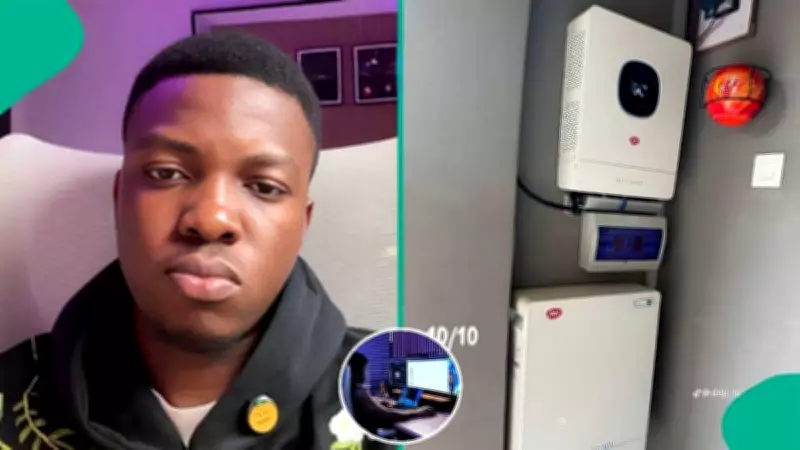
A Nigerian man has become an online sensation after revealing how he achieved round-the-clock electricity in his home by installing a 6kVA solar inverter system with lithium batteries. The individual, who shared his experience on TikTok, detailed the entire cost of the setup and how he overcame a major obstacle when his landlord refused to allow him to mount solar panels on the rooftop.
Man Shares Breakdown of Solar Installation Costs
In the viral video, the man explained that he initially planned to install the panels on the roof of his rented apartment, but the landlord denied permission. This forced him to seek an alternative solution, which added extra expenses. He stated: "The inverter, battery, panels, and all accessories cost me 2,392,000 naira, and the total installation cost was 166,400 naira. My landlord refused to let me put panels on the roof, so I had to get this alternative because I really needed light. This cost me 435,000 naira, which was an unnecessary cost."
After completing the installation, he now enjoys uninterrupted power supply, allowing him to sleep and work at his convenience. He added: "This setup essentially gives me 24/7 light with my current usage. I don't know how it would be in the future, but right now, it is sufficient. My experience has been really good. I can sleep whenever I want and work whenever I want."
Full Cost Breakdown of the Solar System
The man provided a detailed list of all components and their prices:
- ITEL 48V 5kWh lithium battery: N900,000
- 6kVA 48V inverter: N550,000
- Jinko 615W solar panel (5 pieces): N675,000
- 10mm solar cable (30 meters @ N6,500/m): N195,000
- AC breaker: N15,000
- DC breaker: N15,000
- AC surge protector: N15,000
- DC surge protector: N15,000
- Breaker box: N12,000
- Total for components: N2,392,000
Additional costs for the alternative mounting structure:
- Solar port frame: N329,000
- Solar port footing: N106,000
- Total: N435,000
Installation expenses:
- Bolt and nut (2 dozen): N10,400
- Trunking: N2,000
- Cable lugs (4 pcs): N4,000
- Changeover switch: N18,000
- Automatic Voltage Regulator: N12,000
- Installation labor: N120,000
- Total: N166,400
Final total: N2,993,400
Reactions from Social Media Users
The video sparked a wave of comments from Nigerians, with many sharing their thoughts on the setup and its cost. User EverydayUser noted: "Whoever advised you on the 6kVA inverter did you well. Now all you need to upgrade in the future is the battery and adding more panels." Lil_Non said: "We're using the same setup… but I'm powering mine with grid because Itel panel is out of stock, even Jinko, and I don't want to end up buying fake panels."
Ozorclinton shared a similar experience: "Lol, you got lucky you didn't mount that panel on the roof. Exactly the same thing happened to me, and I constructed my own car port. After rain fell for the year, we found out the roof of the building was heavily leaking despite the house being a new building. If I had mounted my panels on the roof, the blame for the leak would have been shifted to me."
Only1everest commented: "Omoiii, well it's a good job, but they sold it to you at a high price." HORLARMITOLEKAN asked: "Where una dey see dis money na... help a brother." Classic Golden inquired: "Does it carry your AC? I bought this same battery and same inverter on Saturday, but I'm going for panels this week, 6 pieces too. But my question again: does it carry AC? I bought those two on Saturday at Alaba for 1.620 million, just the cost of the battery and inverter."
PROMISE | VIDEO EDITOR wrote: "This is good, but the fact that we are just adapting while the nation gets worse is really sad." SNIPER P asked: "Bro, what work do you do, please, so I can go and learn."
Similar Story: Man Borrows Money for Solar Setup, Faces Landlord Issues
In a related story, a Nigerian man who borrowed money to purchase a solar inverter and panels cried out online after his landlord stopped him from installing the system on the rooftop. The man, identified as @DifferentKaro, said he took a loan to buy the solar setup due to persistent power outages but ran into problems when he tried to mount the panels on the building roof.
Review of Itel Power Tank
Meanwhile, another Nigerian who uses the Itel Power Tank shared his experience with the device, revealing how long it lasts after charging. The user said the power tank can run for up to two days, depending on usage, and powers his phone, laptop, power bank, rechargeable lamp, and a rechargeable fan throughout the night. He also disclosed the amount he paid for the 1KWh Itel Power Tank.