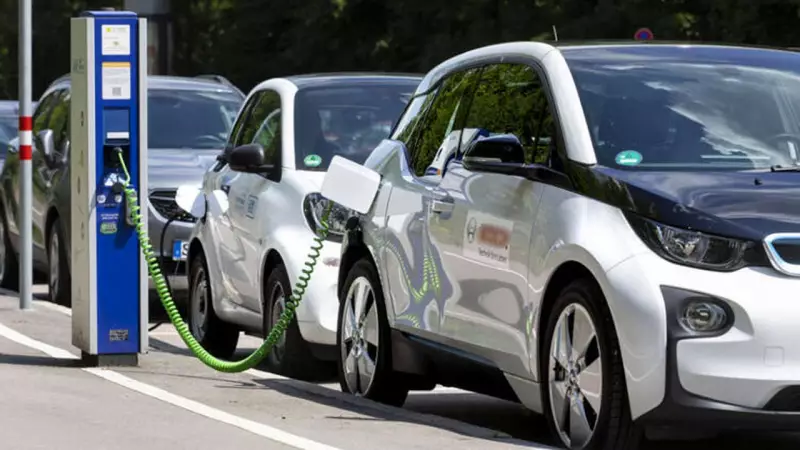
Nigeria's market for electric vehicles is expanding at a remarkable pace, with a staggering 400 per cent increase in adoption recorded over the last five years. This significant shift was highlighted by Mr. Imran Oladimeji Hamzat, the Executive Chairman and Managing Director of LUG West Africa.
Ambitious Plans for Lagos and Beyond
Speaking at the company's 2025 end-of-year party in Lagos, Hamzat unveiled major expansion plans for 2026. The cornerstone of this strategy is the establishment of a local assembly plant for street lighting infrastructure and the ambitious installation of over 250 electric vehicle charging points across Lagos State.
The event saw the presence of notable dignitaries including the Deputy Governor of Lagos State, Dr. Kadri Obafemi Hamzat, and Ogun State's Commissioner for Local Government and Chieftaincy Affairs, Ganiyu Hamzat, alongside other government officials and industry stakeholders.
Solar Power Driving the EV Revolution
Hamzat explained that his company is integrating its existing solar-powered street lighting infrastructure with new EV charging solutions. With over 50,000 solar street lights already installed in Lagos, this network provides a ready foundation for the new project.
He detailed the technical synergy: a setup integrating seven monocrystalline solar panels, each producing 36 volts, can generate enough power to charge one electric vehicle. This configuration can cover about a 200-metre stretch of road, making it a scalable solution.
"Each electric vehicle requires about 240 volts to achieve an hour of charging capable of covering approximately 40 miles, roughly the distance between Lagos and Abeokuta," Hamzat stated.
Addressing the Infrastructure Gap
The push for charging stations addresses a critical need. Nigeria currently has over 11 million vehicles. Hamzat pointed out that global trends suggest EVs could make up about 10 per cent of vehicles on Nigerian roads by 2030. An 8 per cent adoption rate would translate to nearly 850,000 electric vehicles, creating immense demand for public charging infrastructure.
"Not all EV owners would be able to charge their vehicles at home, making roadside charging points essential to prevent vehicle breakdowns and ensure smooth mobility," he emphasized. He believes the planned 250 charging stations in Lagos would be sufficient to support the projected national number of EVs.
The company already has a working prototype and expects to produce a test sample by 2026. The project is designed as a Pan-Nigeria initiative, with LUG West Africa collaborating with global partners for a nationwide rollout.
The new assembly plant being built in Lagos will assemble street lighting systems and manufacture components for EV charging stations, a move expected to boost job creation and local capacity development.
The end-of-year celebration also served as a staff recognition event, with cash rewards and gifts presented. Attendees won prizes ranging from ₦100,000 to ₦600,000, and 10 solar-powered fans were distributed, with one lucky guest taking home the ₦600,000 grand prize.