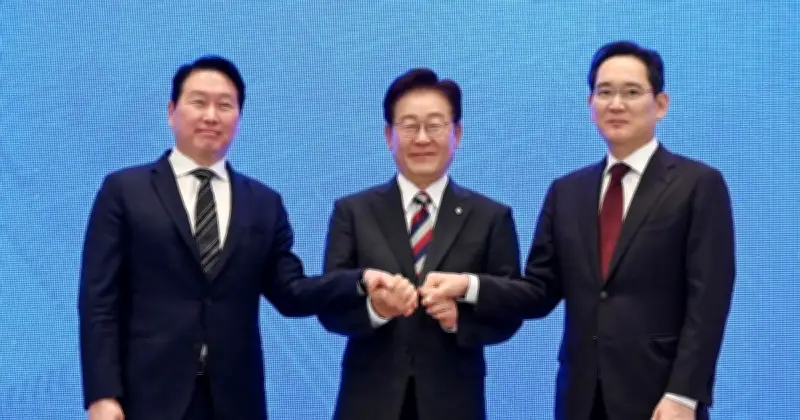
South Korea has unveiled a historic 1.6 quadrillion won ($1.2 trillion) public-private blueprint to build massive semiconductor hubs and expand global AI data center capacity, with Samsung Electronics and SK hynix leading the expansion. The project includes four new semiconductor fabrication plants and a long-term plan to construct advanced AI data centres, aiming to transform the country into a stronger AI and semiconductor powerhouse.
Government and private sector collaboration
Speaking at the launch in Seoul, President Lee Jae Myung emphasized the importance of speed in the AI race. 'Speed is the only path to survival. We must secure the core elements of artificial intelligence faster than any other nation,' President Lee said. The initiative is one of the largest industrial investment drives in South Korea's history, aimed at strengthening the country's position as a global technology leader as demand for AI chips and data centres surges worldwide.
Samsung and SK hynix to lead semiconductor expansion
As part of the plan, Samsung and SK hynix will jointly invest 800 trillion won (about $520 billion) to build a massive semiconductor manufacturing hub in South Korea's southwestern region. The project includes four fabrication plants, with each company constructing two facilities. Industry Minister Kim Jung-kwan stated, 'We will develop the southwestern region into a second semiconductor production hub.' He added that the government would fast-track approvals to help companies begin production sooner. 'Permit approvals and construction timelines will be dramatically shortened to rapidly expand production capacity. Through this, we will maintain an overwhelming market leadership and a decisive technological gap in the memory semiconductor sector.'
Government investment in AI data centres
The South Korean government has committed roughly $650 billion over the next decade to build data centers capable of delivering over 18.4 gigawatts of computing power. Science Minister Bae Kyung-hoon announced that the first phase will see 550 trillion won invested by 2029 before expanding further. 'By 2035, an additional 10-gigawatt AI data centre will be built, with a total investment exceeding 18.4 gigawatts and 1,000 trillion won,' he said. These facilities are expected to provide the computing power needed for AI development, cloud services, and next-generation digital industries.
Focus shifts to South Korea's southwest
A key part of President Lee's economic strategy is directing more industrial investment outside the Seoul region. The semiconductor hub will be built in Honam, which includes Gwangju and the Jeolla provinces, areas that have historically received less industrial development. However, some experts warn of challenges. Kim Dae-jong, a Business Administration professor at Sejong University, said, 'It is essential to minimise the financial burden, amounting to hundreds of trillions of won, as well as the time-related risks faced by companies.'
Skilled workers and infrastructure remain major challenges
Industry analysts note that the southwest offers abundant renewable energy resources, making it attractive for semiconductor manufacturers aiming to meet sustainability targets. However, building an entirely new semiconductor ecosystem from scratch will require significant investment beyond factories. Lee Jong-hwan, a semiconductor engineering professor at Sangmyung University, stated, 'The biggest challenge is that most skilled workers and suppliers remain concentrated around the Seoul metropolitan area. Establishing production lines from scratch could take more than five years.' Another concern is the massive amount of water required for semiconductor production. President Lee recently said government assessments showed the region could supply one million tonnes of industrial water per day, easing some concerns.
AI boom reshaping South Korea's economy
The investment comes as South Korea seeks to capitalise on the global artificial intelligence boom, with demand for advanced semiconductors rising as companies expand AI services and data centre capacity. The rapid growth has also sparked debate over how AI-driven economic gains should be shared. Earlier this year, presidential policy chief Kim Yong-beom proposed using additional tax revenues from the AI industry to fund startup support for young entrepreneurs, rural basic income programmes, and financial assistance for artists. Meanwhile, booming profits in the semiconductor sector have strengthened workers' demands for higher compensation. Samsung recently avoided a major strike after reaching a bonus agreement with its largest labour union.
With more than $1 trillion earmarked for AI infrastructure and semiconductor manufacturing, South Korea is positioning itself to remain one of the world's most important players in the race to dominate the next generation of artificial intelligence technology.