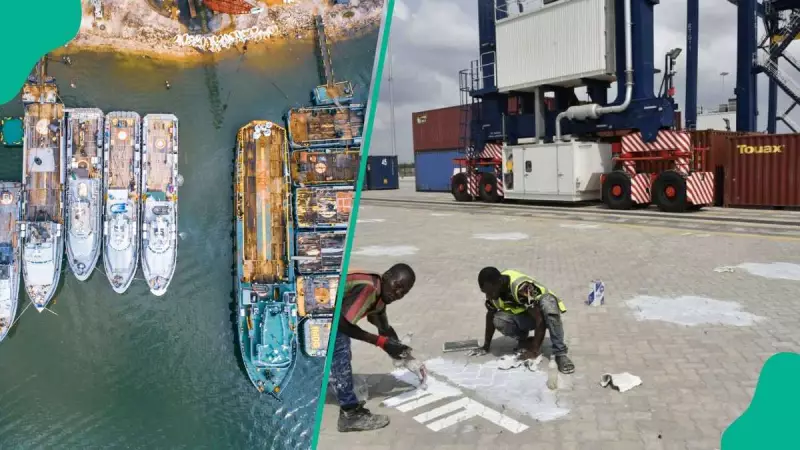
Importers and freight forwarders operating at Nigeria's seaports have issued a stern warning, threatening to shut down operations if the federal government does not urgently intervene to halt recent increases in cargo handling charges imposed by foreign shipping lines.
Stakeholders Petition President Tinubu Over Rising Costs
The groups, which include licensed customs agents, have formally petitioned President Bola Tinubu. They argue that the escalating tariffs are severely worsening the cost of doing business, slowing down vital supply chains, and ultimately pushing prices higher for Nigerian consumers. This development was reported by The Sun newspaper.
Freight agents have cautioned that if the hikes continue unchecked, they could trigger widespread protests or major disruptions at port facilities across the country.
Details of the Approved Charge Increases
The latest controversy stems from a revised schedule of charges announced by the Mediterranean Shipping Company (MSC), following approval from the Nigerian Shippers' Council. The new rates took effect from January 1, 2026.
According to the notice, the Import Documentation Fee for a 20-foot container has risen from N45,000 to N58,500. For a 40-foot container, the fee increased from N72,000 to N93,600.
Furthermore, Port Additional Charges were also significantly raised. Fees for a 20-foot container jumped from N50,000 to N80,000, while charges for a 40-foot container surged from N100,000 to N160,000.
Industry players state that this is part of a pattern of increases throughout 2025. They point out that in March of last year, shipping giant CMA CGM raised local charges on Nigeria-bound cargo. Around the same period, the Nigerian Ports Authority (NPA) also implemented a 15% hike in port tariffs.
Shippers' Council Defends Marginal Review
At a stakeholders' meeting in Apapa, the Executive Secretary and CEO of the Nigerian Shippers' Council, Dr. Pius Akutah, confirmed that the council approved a marginal review of some charges. He explained that shipping companies had requested the review since early 2025, citing pressures from inflation, foreign exchange fluctuations, and rising operational costs.
Akutah added that the shipping firms were directed to properly inform and sensitize their customers before rolling out the new charges, noting that some consultations had already taken place.
Importers and Agents Reject Explanations, Warn of Consequences
However, maritime stakeholders have strongly rejected these explanations. An importer, Mr. Pius Chijioke, told The Sun that the increases would further reduce the competitiveness of Nigerian ports and accelerate the diversion of cargoes to neighboring countries. He urged the federal government to suspend the implementation and ensure broader engagement.
Sulaiman Ayokunle, Managing Director of Sula Marine Global Limited, stated that sudden tariff hikes disrupt careful business planning, especially for importers relying on bank financing and pre-arranged budgets.
The Association of Nigerian Licensed Customs Agents (ANLCA), Western Zone, also expressed deep concern. Its coordinator, Alhaji Femi Anifowose, revealed that shipping companies, particularly MSC, were planning increases of up to 30% on documentation fees and 60% on port charges.
Anifowose said the association has written to President Tinubu, urging him to direct the Minister of Marine and Blue Economy and relevant regulators to halt the planned increases. He argued that the reasons cited by shipping lines, such as fuel prices and forex pressures, have stabilized in recent months.
He issued a clear warning: failure to address this issue could lead to protests or a withdrawal of services by freight agents, paralyzing port operations. He called on the government to protect port users and ensure greater transparency in the maritime sector.
The collective grievance centers on the belief that the cumulative effect of multiple charge reviews has made Nigerian ports among the most expensive globally and the costliest in West and Central Africa, leading to significant cargo diversion.