
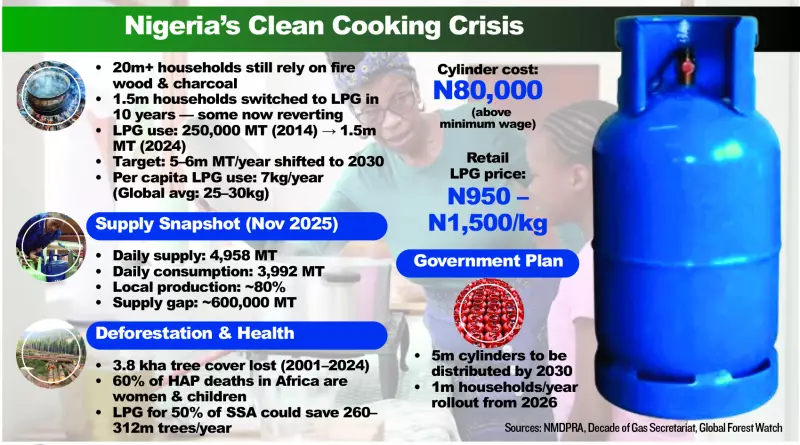
More than 20 million households in Nigeria continue to depend on firewood and charcoal for their daily cooking needs. This persists despite a decade of government policies, increased local gas production, and significant private investment exceeding $500 million. The primary barriers remain the high cost of Liquefied Petroleum Gas (LPG) and poor distribution networks, stalling the nation's shift to cleaner energy.
The High Cost of Clean Cooking
The single biggest obstacle to adopting cooking gas is the upfront cost of the cylinder. Damilola Owolabi-Osinusi, Managing Director of Selai Gas, highlighted that a standard 12.5kg steel cylinder now sells for about N80,000—a figure higher than the national minimum wage. Refilling this cylinder costs between N12,500 and N15,000, with LPG retail prices ranging from N950 to N1,500 per kilogramme.
For millions in rural and peri-urban areas, this is simply unaffordable. "When households compare gas with firewood or charcoal, gas loses out. Their priority is to cook and eat, not the long-term health implications of smoke inhalation," Owolabi-Osinusi stated. She called for government support to local manufacturers through tax waivers and stable power to reduce production costs.
Government Plans and Persistent Challenges
The Federal Government, through the National Gas Expansion Programme and the Decade of Gas initiative, insists it is committed to changing the narrative. Ed Ubong, Coordinating Director of the Decade of Gas Secretariat, told The Guardian that ceremonial launches for a free cylinder distribution scheme have been completed across the six geopolitical zones.
The plan is to distribute one million cylinders annually starting in 2026, with an overall target of reaching five million homes by 2030. However, energy marketers and experts warn that this programme, like past interventions, will fail unless the core issue of affordability is tackled directly.
Oladapo Olatunbosun, President of the Nigerian Association of Liquefied Petroleum Gas Marketers, echoed this, stating, "The problem is not awareness but affordability." He advocated for targeted subsidies similar to models in India, Morocco, and Niger.
Health, Environmental and Infrastructural Toll
The continued reliance on biomass fuels carries a severe human and environmental cost. Dr. Riverson Oppong, Africa Regional Director of the Society of Petroleum Engineers, noted that household air pollution from firewood is responsible for about a quarter of global deaths from stroke and chronic diseases. Women and children in rural areas bear the highest risk.
Environmentally, the demand for firewood and charcoal drives deforestation. Global Forest Watch data shows Nigeria lost 3.8 kha of tree cover between 2001 and 2024. In just one week in late December 2025, the country recorded 1,603 deforestation alerts.
On the infrastructure front, Emmanuel Omuojine of Rainoil Gas Limited noted progress, with local LPG supply now meeting about 80% of demand and imports cut by over 50%. However, a supply gap of at least 600,000 tonnes remains. Poor roads, ageing trucks, and inadequate rural retail infrastructure cripple last-mile delivery, often forcing households that had switched back to charcoal.
The safety of existing cylinders is another concern. Nigeria has over four million LPG cylinders in circulation, with nearly 1.8 million past their 10-15 year lifespan, increasing risks of leaks and explosions—a danger tragically demonstrated by a deadly blast in Sagamu, Ogun State, in July.
As trader Ebi Wonodi in Yenagoa, Bayelsa State, summarised, "Gas is too expensive now. I don't have a choice." Her sentiment, shared by millions, underscores the urgent need for a holistic solution that makes clean cooking not just an ideal, but an affordable reality.




