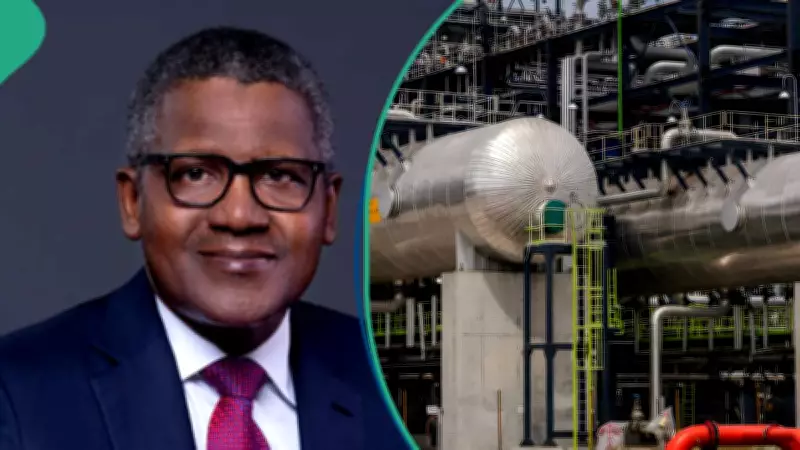
Federal Government Suspends Petrol Import Licenses in Major Policy Shift
In a decisive move that reshapes Nigeria's downstream petroleum sector, the Federal Government has officially suspended the issuance of petrol import licenses to major oil marketing companies. This strategic policy adjustment significantly strengthens the market position of Aliko Dangote's massive refinery project, which has rapidly become the dominant supplier of Premium Motor Spirit across the nation.
Dangote Refinery Now Supplies Majority of National Petrol Demand
Recent data from the Nigerian Midstream and Downstream Petroleum Regulatory Authority reveals a dramatic transformation in Nigeria's fuel supply landscape. During February, the Dangote Refinery supplied approximately 64% of the country's total petrol consumption, operating at around 78% of its 650,000 barrels per day processing capacity. The remaining supply gap was filled using existing fuel stocks previously imported into Nigeria.
Under the new regulatory framework established by the government, petrol import permits will only be granted in situations where domestic production cannot meet national demand. According to NMDPRA spokesperson George Ene-Ita, Nigeria's current refining output has reached sufficient levels to justify the suspension of fresh import licenses, marking a significant milestone in the country's energy independence journey.
Major Oil Marketers Affected by License Suspension
The policy change directly impacts several prominent oil marketing companies that previously imported substantial quantities of petrol into Nigeria. Companies including TotalEnergies SE, MRS Oil Nigeria Plc, and Conoil Plc, which collectively accounted for roughly 25% of petrol imports in January, now face a transformed operating environment. These marketers must now primarily depend on locally refined fuel, with the Dangote refinery positioned as their main supply source for maintaining distribution networks nationwide.
This regulatory shift represents one of the most significant transformations in Nigeria's downstream petroleum market in decades, fundamentally altering the competitive dynamics between importers and domestic refiners.
Legal Dispute Preceded Policy Implementation
The government's decision follows a previous legal confrontation between Dangote's refinery and industry regulators. Earlier, Dangote had filed a lawsuit challenging the approval of petrol import licenses granted to NNPC Limited and several private firms. The billionaire industrialist argued that continued fuel imports undermined Nigeria's growing domestic refining capacity and represented unfair competition against local production.
Among the companies named in the legal action were AYM Shafa Ltd, A.A. Rano Ltd, T. Time Petroleum Ltd, 2015 Petroleum Ltd, and Matrix Petroleum Services Ltd. The refinery initially sought ₦100 billion in damages, claiming regulators continued to approve imports of diesel and aviation fuel despite available local supply. However, the case was eventually withdrawn as relations between the refinery and government authorities improved.
Ambitious Expansion Plans Underway
Bolstered by its strengthened market position, Dangote Group is advancing ambitious plans to significantly expand its refining and petrochemical operations. The conglomerate recently signed two major agreements worth $750 million with XCMG Group and Engineers India Limited to dramatically increase the refinery's capacity.
The expansion project aims to boost the refinery's processing capability to approximately 1.4 million barrels per day, potentially positioning it as one of the largest refining complexes globally. Industry analysts predict this expansion could transform Nigeria's energy sector by eliminating the country's reliance on imported fuel and establishing Nigeria as a major exporter of refined petroleum products within Africa.
Market Dynamics and Competitive Pricing
The policy shift occurs amid evolving market dynamics, including recent data from the Major Energies Marketers Association of Nigeria indicating that the landing cost of imported petrol has fallen below the price offered by Dangote Refinery. According to MEMAN figures, imported Premium Motor Spirit had a landing cost of N809.37 per litre, approximately N64 cheaper than Dangote refinery's N874 per litre gantry price.
This pricing differential has triggered renewed discussions between fuel importers and the refinery, highlighting the complex economic considerations surrounding Nigeria's transition toward domestic refining. The situation unfolds against a backdrop of global tensions in the Middle East involving the United States, Iran, Israel, and other nations, which continue to influence international oil markets and pricing structures.
If successfully implemented, Nigeria's strategic shift toward local refining may mark the beginning of a new era for the country's petroleum industry, with the Dangote refinery positioned at the center of this transformative process. The policy represents a calculated effort to encourage domestic refining capacity while reducing Nigeria's long-standing dependence on imported petroleum products.