
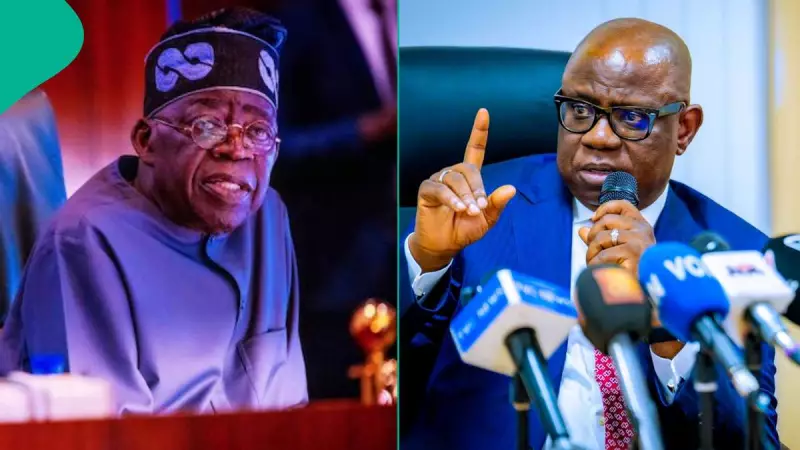
President Bola Tinubu has given his approval for the cancellation of a massive debt burden previously held by the Nigerian National Petroleum Company Limited (NNPCL). The move, which involves $1.42 billion and 5.57 trillion naira, is aimed at cleaning up the state oil firm's financial records and enhancing operational transparency.
Lawmaker Applauds Presidential Directive
In a statement released on Friday, January 2, 2026, Philip Agbese, the Deputy Spokesperson for the House of Representatives, commended President Tinubu for the decisive action. Agbese described the debt forgiveness as a strong endorsement of the leadership provided by the NNPCL Group Chief Executive Officer, Engr. Bashir Bayo Ojulari.
He emphasized that the presidential directive came after a detailed reconciliation process conducted by the Stakeholder Alignment Committee. According to Agbese, this step represents a clear vote of confidence in Ojulari's management and his commitment to a new era of openness at the corporation.
Linking Debt Relief to NNPC's Achievements
Agbese directly connected the debt cancellation to the tangible progress made under Ojulari's watch. He highlighted that the NNPCL has opened its financial books more than ever before, enabling the accurate resolution of long-standing disputes and making this historic clean slate possible.
The lawmaker pointed to several key achievements, including:
- Record-breaking upstream performance: NNPC Exploration and Production Limited reportedly achieved a daily output of 355,000 barrels on December 1, 2025, marking the highest production level in 36 years. National output is now climbing towards over 1.7 million barrels per day.
- Major infrastructure milestone: The completion of the main line welding for the $2.8 billion Ajaokuta-Kaduna-Kano (AKK) gas pipeline, including the challenging River Niger crossing, which is seen as a game-changer for the nation's energy infrastructure.
- Restored financial reporting: The resumption of regular monthly financial and operational reports, boosting stakeholder confidence.
Agbese argued that these accomplishments have repositioned the NNPCL as a commercially viable entity and justified the trust placed in its current leadership.
Assessing Future Targets and Downstream Progress
Speaking on the NNPCL's ambitious target of achieving 1.8 million barrels per day in 2026, Agbese assessed the goal as both realistic and forward-looking. He noted that this target is backed by the provisions of the Petroleum Industry Act (PIA).
On the downstream sector, the lawmaker acknowledged significant progress in the rehabilitation of the Port Harcourt Refining Company. He stated that these efforts align with broader national initiatives to boost domestic refining capacity and reduce Nigeria's dependence on imported petroleum products.
"Engr. Ojulari's transparent leadership has not only resolved historical burdens but is building a stronger, more accountable national oil company for all Nigerians," Agbese concluded in his statement.
Contrasting View on NNPC's Integrity
This positive assessment comes against the backdrop of a recent evaluation by the Independent Corrupt Practices and Other Related Offences Commission (ICPC). In its 2025 Ethics and Integrity Compliance Scorecard, the ICPC scored the NNPCL zero, placing it at the very bottom of 357 federal ministries, departments, and agencies assessed nationwide.
That outcome had reignited significant public concern about governance and accountability within Nigeria's crucial oil and gas sector. The debt write-off approved by President Tinubu appears to be a strategic financial intervention aimed at addressing some of these legacy issues and enabling the corporation to chart a new course under its current management.




