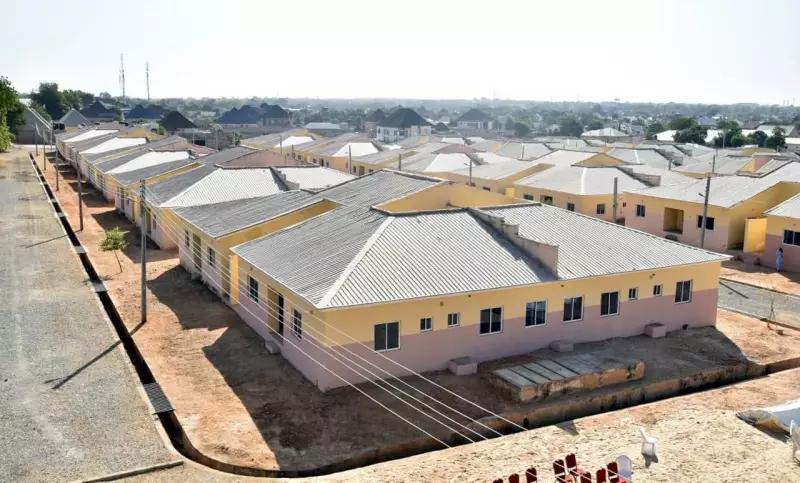
Built environment professionals have called on the Federal Government to integrate its housing delivery strategy into the National Housing Policy. This move, they argue, is crucial for ensuring long-term sustainability and making a significant impact on Nigeria's massive housing deficit.
Data-Driven Policy and Infrastructure Focus
The experts advised the Ministry of Housing and Urban Development to systematically collect data and feedback from the ongoing Renewed Hope Estates initiative. This information should then be used to refine future housing strategies and improve policy implementation.
Leading this call was Dr Meckson Okoro, Principal and CEO of M.I. Okoro & Associates. He stated that the Renewed Hope Housing Programme is aligning Nigeria with global best practices. Okoro emphasized that for housing costs to drop, government must prioritize land, finance, and infrastructure.
He proposed direct land allocation for developments and deliberate government provision of infrastructure like roads, electricity, and water. "If developers are left to provide roads, electricity, water and other infrastructure, the cost will be transferred to buyers," Okoro warned. He also recommended that every federal housing estate incorporate solar power solutions to reduce reliance on generators.
Mortgage Oversight and Professional Allocation
While praising the government's mortgage-backed funding with its 20-year tenure and single-digit interest rates, Okoro raised concerns about accessibility. He urged the Central Bank of Nigeria (CBN) to intensify oversight of banks disbursing funds under the scheme to prevent delays.
Okoro also pledged strict professionalism in allocating housing units. He noted that sustaining this strategy to deliver millions of homes would generate steady revenue for states through ground rent and land-use charges. He recommended extending the Renewed Hope model to all states and local governments, arguing that increased supply would naturally lower prices more effectively than price-control laws.
Project Scale and Partnership Details
The discussions took place during the signing of a Memorandum of Understanding (MoU) between QShelter Limited and M.I. Okoro & Associates for the marketing of Renewed Hope Housing estates in Abuja, Kano, and Lagos.
Alamu Adegbenga, Chief Operating Officer of QShelter Limited, disclosed that the Ministry, with Continental and General Construction Company (CCGCC), plans to deliver 100,000 housing units nationwide. This includes 20,000 units each in Abuja and Lagos, and 60,000 units across the 36 states.
QShelter will deliver about 2,800 units in Abuja and 2,000 in Kano, featuring various bedroom options. The homes will be available through:
- Outright purchase
- 12-month installment plans with 25% down payment
- NHF mortgages at 6% interest
- Rent-to-own schemes
The first phase of 600 to 700 units in Abuja is expected to be commissioned in 2026. Construction has also begun at the 2004 Monastery Estate along the Coastal Road in Sangotedo, Lagos, which will yield over 2,300 units.
Kola Sowande, Chairman of QShelter Limited, said the partnership aims to support the government with transparency and global best practices. The collaboration will focus on affordability for low-income earners and young Nigerians aged 21 to 35.
Victor Alonge, President of the Nigerian Institution of Estate Surveyors and Valuers (NIESV), suggested reserving a defined percentage of units for low-income earners, civil servants, and essential workers. Fred Adegeye of the Nigeria UK Golfing Association noted that flexible payment plans would attract diaspora Nigerians, whose remittances reached about $21 billion in 2024.