
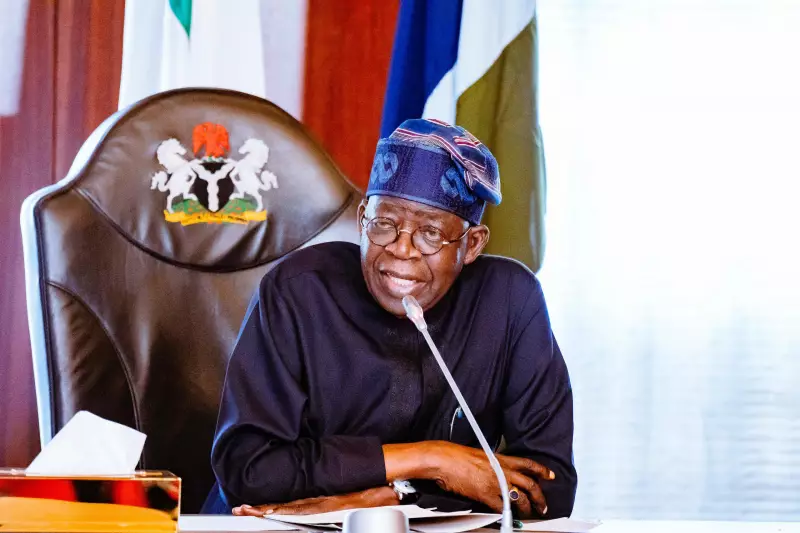
President Bola Ahmed Tinubu has hailed a landmark achievement for the Nigerian economy as the Nigerian Exchange (NGX) surged past the historic N100 trillion market capitalisation threshold. The President commended corporate entities, investors, and all market stakeholders for this feat, describing it as a pivotal moment that should bolster confidence in the nation's financial markets.
A New Economic Reality for Nigeria
In an official statement, President Tinubu declared that crossing the N100 trillion mark signals the birth of a new economic reality and rejuvenation for the country. He called on Nigerians to seize this momentum and channel more investments into the domestic economy, emphasizing that the administration's ongoing reforms are set to deliver even stronger returns in 2026.
The President contrasted Nigeria's performance with global trends, noting that while many international markets faced stagnation or weak recovery in 2025, the NGX All-Share Index recorded an exceptional 51.19% return. This growth significantly outperformed the 37.65% gain posted in 2024 and positioned Nigeria among the world's top-performing markets.
Outpacing Global and Emerging Market Peers
"This performance ranks among the highest in the world," Tinubu stated. He highlighted that the year-to-date returns have substantially exceeded those of major indices like the S&P 500 and the FTSE 100, as well as many peers within the BRICS+ group of emerging economies.
He asserted that Nigeria can no longer be sidelined as just a frontier market. Instead, the nation is now a compelling destination where genuine value is being discovered. "As the stock market reflects the entire economy, its stellar performance is a strong indicator of economic health and the confidence investors have in Nigeria," the President added.
Sectoral Strength and Future Listings
Tinubu pointed to broad-based growth across key sectors on the NGX. He praised industrial firms that have successfully localised their supply chains and commended the banking sector for its resilience, driven largely by technological innovation.
According to the statement released by Special Adviser on Information and Strategy, Bayo Onanuga, the pipeline for new public listings remains robust. The President revealed that indigenous energy companies, technology firms, telecommunications operators, and infrastructure-heavy entities are preparing to access the public market to fund their expansion plans.
"As these firms are listed, they will further boost market capitalisation and deepen democratic ownership of the Nigerian economy," Tinubu projected.
Link to Macroeconomic Improvements
The President directly linked the capital market's success to broader improvements in the national economy. He noted that inflation, which hit a 24-month high of 34.8% in December 2024, has begun a steady decline.
Tinubu attributed this positive shift to decisive monetary policy tightening, the elimination of the distortionary "Ways and Means" financing, and increased investment in agriculture. By November 2025, inflation had decelerated to 14.45%, with projections indicating it could fall to around 12% in 2026.
"Indeed, inflation is likely to fall below 10 per cent before the end of this year," the President said optimistically, forecasting that this trend will lead to improved living standards and faster GDP growth for the nation.




