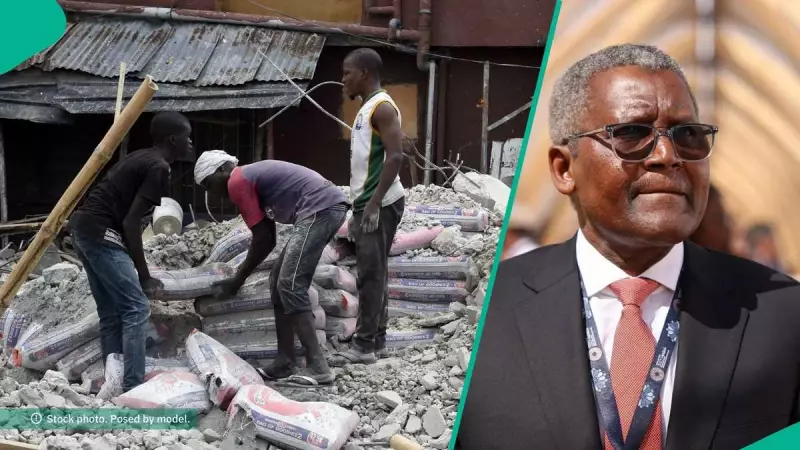
Nigerian industrialist Aliko Dangote has provided a detailed explanation for the persistent disparity in cement prices, revealing why products from his conglomerate are often cheaper in foreign markets than within Nigeria itself. The billionaire attributes this counterintuitive situation to the heavy burden of taxes and regulatory levies imposed on domestic sales.
The Tax Burden Inflating Domestic Prices
In a recent clarification, Dangote outlined the specific fiscal policies that significantly increase the cost of cement for Nigerian consumers. He stated that when selling cement domestically, his company is obligated to pay a suite of charges that are not applicable to exports.
"When you look at my invoice, the cement I export is cheaper than the one I’m selling domestically," Dangote explained. He detailed the exemptions enjoyed by exported cement, which include not paying a 30% income tax, a 2% education levy, a 1% health levy, 7.5% Value Added Tax (VAT), or a 10% withholding tax.
These exemptions, he argued, are standard for exports and are what allow Nigerian-produced cement to remain competitive against major international producers from countries like Turkey, Russia, and China. Dangote emphasized that simply manufacturing locally is not a silver bullet for high prices, as structural costs within the Nigerian economy play a decisive role.
Ongoing Concerns Over Cement Affordability
The issue of cement pricing has been a major concern for both the government and the public, directly impacting construction and housing affordability. Currently, a 50kg bag of cement sells for between N9,500 and N10,200 across Nigeria.
Earlier in February 2025, the Minister of Works, Senator Engr. Nweze David Umahi, appealed to manufacturers to reduce the price to around N7,000 per bag. His appeal was based on improvements in the exchange rate and a reduction in petrol costs. Prior to this, prices had soared due to severe currency depreciation.
Similarly, in February 2024, the Minister of Housing and Urban Development, Musa Dangiwa, expressed alarm that escalating cement costs were jeopardizing housing delivery programs aimed at low- and middle-income Nigerians. He urged manufacturers to seek innovative solutions rather than automatically passing all costs onto consumers.
Dangote's Broader Defence and Industry Performance
Dangote also addressed criticisms surrounding his Dangote Refinery, a project designed to end Nigeria's perennial fuel shortages. He expressed frustration that the refinery, which has the potential to stabilize fuel supplies, create jobs, and reduce foreign exchange pressure, has faced opposition over market dominance concerns.
"Since when has Nigeria been having problems with fuel queues? Since 1972," Dangote remarked. "Somebody has addressed this problem, and you’re calling the company names." He advocated for more domestic investment in the energy sector to naturally balance market dynamics and strengthen regulation, instead of relying on imports to control prices.
Despite the pricing challenges, the cement industry in Nigeria remains profitable. Data shows that three major producers listed on the Nigerian Exchange Limited (NGX)—Dangote Cement Plc, BUA Cement Plc, and Lafarge Africa Plc—generated a combined revenue of N677.34 billion in 2024. This marks a 17.55% increase from the N576.18 billion reported in 2023.
Dangote Cement maintained its position as the sector's most profitable entity, reporting a profit of N503.2 billion for the full year 2024, a 10% increase from the N455.6 billion earned in 2023. The Dangote Group also reaffirmed its status as Nigeria's largest taxpayer, a position it has held for many years.
The industrialist's comments underscore a call for broader economic reforms to reduce the structural costs that make essential commodities like cement disproportionately expensive for the average Nigerian consumer.