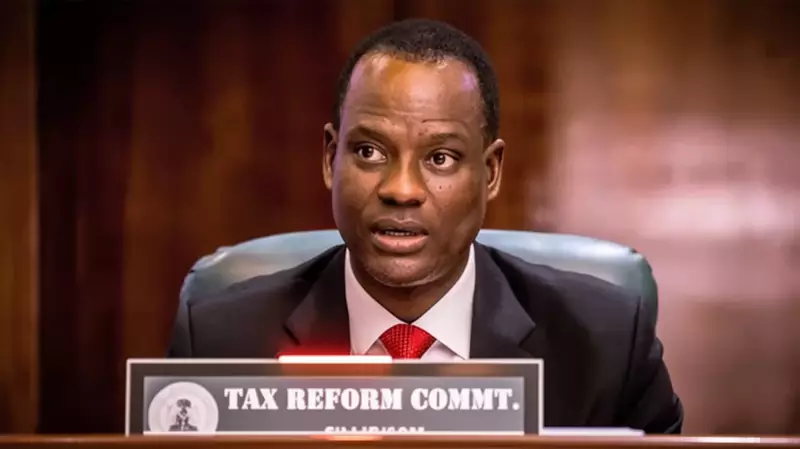
The Chairman of the Presidential Committee on Fiscal Policy and Tax Reforms, Taiwo Oyedele, has made a startling revelation about Nigeria's tax system. He disclosed that about 96 per cent of personal income tax historically collected in the country came from low-income earners. Oyedele described this structure as fundamentally unjust and unsustainable for the nation's economy.
A System Designed to Tax Poverty
Oyedele shared these details at the Cowry Quarterly Economic Discourse, an event designed to provide clarity and direction on economic matters. He firmly dismissed widespread claims that the newly enacted 2026 tax reform law would increase the cost of living for Nigerians. Instead, he insisted the reform's core objective is to increase disposable income and reduce prices of basic goods.
Speaking at the discourse themed “Nigeria in 2026: Will Politics Trump Economic Reform?”, Oyedele argued that negative narratives are fueled by misinformation. "The narrative out there is the complete opposite of what is actually contained in the law," he stated. He explained that the reform specifically targets ending the "taxation of poverty" by shielding low-income earners and ensuring those with greater financial capacity pay a fairer share.
Clarifying the New Tax Thresholds
The tax chief provided crucial clarification to address public confusion. He emphasized that under the new framework, any Nigerian earning the national minimum wage is fully exempt from paying personal income tax. Furthermore, the threshold for what is considered taxable income has been significantly raised after accounting for allowable deductions and reliefs.
"The N800,000 people talk about is taxable income, not gross income," Oyedele explained. "By the time you remove deductions and allowances, that translates to about N1 million to N1.2 million gross income. And even at that, anyone earning the minimum wage pays no tax at all." This redesign aims to correct a long-standing distortion where the tax burden fell disproportionately on the poor while wealthier individuals often remained lightly taxed.
Comparative Analysis and the Path Forward
To underscore the abnormality of Nigeria's previous system, Oyedele compared it with South Africa. He noted that South Africa generated over ₦60 trillion from personal income tax last year, with roughly 60 per cent contributed by the top 1.5 per cent of earners. "Here in Nigeria, we struggle to collect about ₦2 trillion from personal income tax despite having four times their population. You cannot reconcile those numbers," he added, highlighting the scale of the challenge.
Oyedele stressed that the 2026 tax reform law was not rushed. It was the product of an extensive, nearly 18-month process involving over 800 stakeholders, including state governments, the private sector, students, and civil society groups. While acknowledging the law may not be perfect, he described it as Nigeria's most deliberate and comprehensive tax overhaul to date.
Looking at the broader economy, Oyedele expressed optimism for 2026, predicting that macroeconomic improvements would start yielding real benefits for households. He issued a stern warning: failing to allow a proper tax system to function would force the government to either continue "taxing the poor" or resort to "printing money," both of which would exacerbate inequality and inflation.
He urged Nigerians to see beyond the misinformation, stating, "If government was collecting more tax from you before and the new law reduces that burden, why should you fight it? This reform is about fairness, growth and improving the lived experience of ordinary Nigerians."