Scholars and historians have unanimously acknowledged Ifa as the greatest multi-cultural institution of the Yoruba people. It is affirmed as an encyclopedia encapsulating the entire ways of life of the Yoruba, including their unique advancements in arts and science. However, Ifa remains a subject of controversy even among the Yoruba originators. The controversy is not about existential questions, originality, or efficacy—tests it has passed for centuries—but centers on religious imputation. Ifa has long been a victim of cultural conflict or collision in a conscious campaign by Western religious irredentists to blacklist or eliminate it, ignoring its efficacious capacity, which sometimes surpasses modern scientific tools.
Without traveling far for evidence of Ifa's uniqueness, exceptionality, and primacy as a foremost Yoruba multi-cultural institution, one need only observe how the Yoruba, from pre-written history, have consciously given Ifa-based names to their children. Names such as Ifabiyi, Fayemi, Fayoose, Fanoro, Fasina, Falana, Falayi, Fasuyi, Fagbemi, Abifarin, and thousands of others carry Ifa prefixes or suffixes. Beyond nomenclature, Ifa has ascended the educational ladder, with its branches being researched at the highest academic levels.
Bifatife's Inaugural Lecture
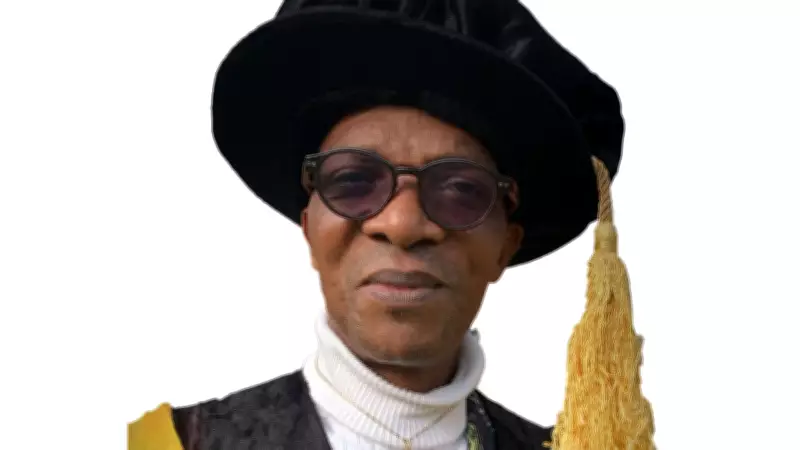
One of the latest entrants in the academic voyage of research on Ifa is Prof. Bifatife Oluyemi Adeseye, Dean of the Faculty of Arts at the Federal University Oye Ekiti (FUOYE). He recently presented FUOYE's 22nd Inaugural Lecture titled 'Ifa In The Drama Of Life: Ancient Wisdom For The Digital Age'. In his lecture, he delved deeply into the history of Ifa's evolution, its characteristics, features, and branches in all aspects of Yoruba life, its achievements among the people, its permeation of modern ways of life, and its modus operandi, among several perspectives he examined.
Bifatife opened his presentation by affirming the tragic misconception of Ifa and referenced scholars who had pointed out the misgivings to which Ifa is unwittingly reduced. To prove these misconceptions unfounded and baseless, he cited research findings by Prof. Sophie Oluwole. "To fully articulate the concept of Ifá, I will align with Prof. Sophie Oluwole (2014) as she has enumerated some of the common misconceptions about the system. Oluwole argued that Ifá is not a religion, but that it contains religion, philosophy, science, and more. It follows, therefore, that Ifá is a comprehensive system that encompasses various aspects of life."
He also corrected attempts to undermine Ifa's prominent place by scholars who linked it to Arabic geomancy due to similarities in notation recorded from right to left. He concluded that "Archeological findings have proved that Ifá predates Arabic influences and is deeply rooted in Yoruba culture."
Defending Ifa's Originality
The lecturer further advanced his argument about the originality and uniqueness of Ifa against misconceptions of Western culture apologists and others. He unveiled the world-view nature of Ifa and the fullness of its exclusive content, not found in any other cultural concept. He fortified his argument in stout defense of Ifa's unassailable integrity with more references from reputed scholars. "It should be emphasised that Ifá is a logically-based spirituality that deals with the mind and the universe, not magic or superstition. If taken as a faculty in an academic institution, Ifá would project courses in the following areas of specialization: Divination, sacred arts, medicine, poetry, religion and philosophy. Ifá medicine, commonly called Traditional or alternative therapy, sub-divides into several areas of specialisation far ahead of the numbers found in most orthodox colleges of medicine (Adeseye 2012)… Ifá stores for posterity, the entire fabric of a people’s life. Ifá is therefore a culture; a world-view of the Yoruba in the Diaspora (Odeyemi 1997, Adeseye 2017)."
Bifatife is not alone in this defense. As far back as 1999, Nobel Laureate Wole Soyinka faulted the apparent relegation of Ifa to the background in world affairs despite its efficacy. In the words of the inaugural lecturer, "Wole Soyinka (1999) invites all and sundry to acknowledge Ifá as the fountain of knowledge; a system that encapsulates the totality of the way of life of the Yoruba, that is also applicable to any race… Ifá as an encyclopedia that is relevant not only to the Yoruba race but also to the global community."
Distinguishing Westernisation from Modernisation
The erudite scholar drew resonating ovation from the gathering of academics, traditional and spiritual fathers, friends, family members, and public officers while defending the topic of the discourse. He brilliantly distinguished between westernisation and modernisation and faultlessly asserted that opponents of Africa's contributions to world modernity or civilisation have consciously undermined and undervalued them through the subjective use of westernisation as the exclusive lens to view modernisation or civilisation. Therefore, the lecture stood as a strategic measure to correct and redress the imbalance and misgivings. He further asserted that every culture is important and must be collectively inclusive when aggregating global culture—a situation that has not been allowed to flourish, especially by apostles of the superiority of Western cultures over others.
Relevance of African Culture
Apart from righting misgivings, the scholar held that the past, which African culture and tradition represent, is very germane to creating the present and moving forward. A cultural prophet, he foresees that "The new process is expected to purify and bring forth the new man, the new African, one who must operate under a new sense of realism, not as a puppet."