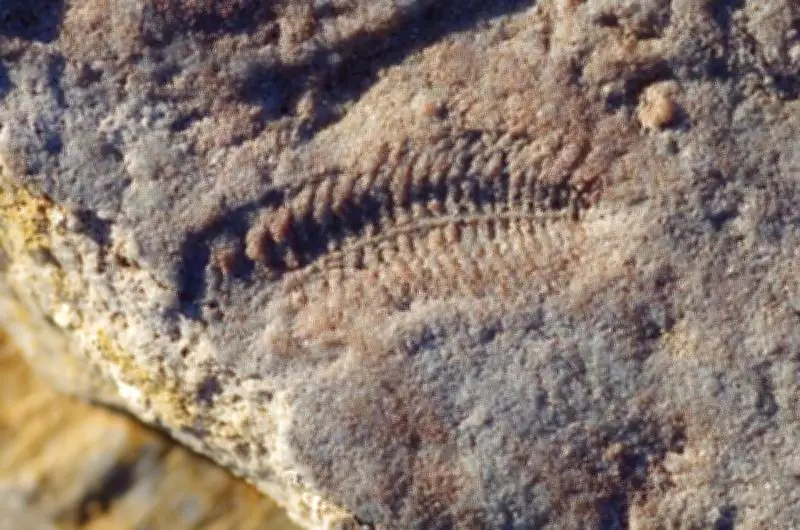
A 550-million-year-old fossil of a wormlike creature called Spriggina floundersi reveals that it was the earliest known animal with a preference for its right side, indicating the evolutionary origins of handedness. The study, published in Scientific Reports, analyzed over 100 fossils from South Australia and found that twice as many specimens bent to the left in rock, meaning they curved to the right in life.
Discovery and Significance
Spriggina floundersi lived during the Ediacaran Period (635–542 million years ago) and is the oldest known animal with a head. Its flat, segmented body tapered at one end and had a curved structure at the other. First described in 1958, scientists debated whether it could move. The new research confirms it could wriggle across the seafloor and exhibited a behavioral handedness similar to modern animals like humans, primates, mice, frogs, and insects.
Evidence of Handedness
Lead author Scott Evans, assistant curator of invertebrate paleontology at the American Museum of Natural History, said: “About twice as many of these things are bent to the left as are bent to the right.” This 2-to-1 ratio matches handedness patterns in modern animals. The researchers ruled out environmental factors like currents or desiccation by finding specimens oriented in different directions with varying degrees of bending, even in the same rock bed.
Movement and Anatomy
The team examined body curves and found that Spriggina could bend deeply enough to form a U shape. Diego García-Bellido, a senior paleontology researcher at the South Australian Museum, noted: “The fact that Spriggina individuals fossilized close together while bending in different directions… indicates that these organisms were not fixed to the seafloor and could actually move.” The fossils measured up to 4 inches (10 cm) long, but most were 0.8–1.2 inches (2–3 cm).
Implications for Evolution
Evans added: “If you push past that weirdness, what we see is that a lot of the fundamental characters that we associate with animals today, things like the ability to move and even having this behavioral handedness, are present in these earliest animal communities.” García-Bellido, who was not involved in the study, praised the researchers for considering alternative hypotheses and providing clear arguments. The findings suggest Spriggina had a nervous system connected to muscles, enabling directional preference.