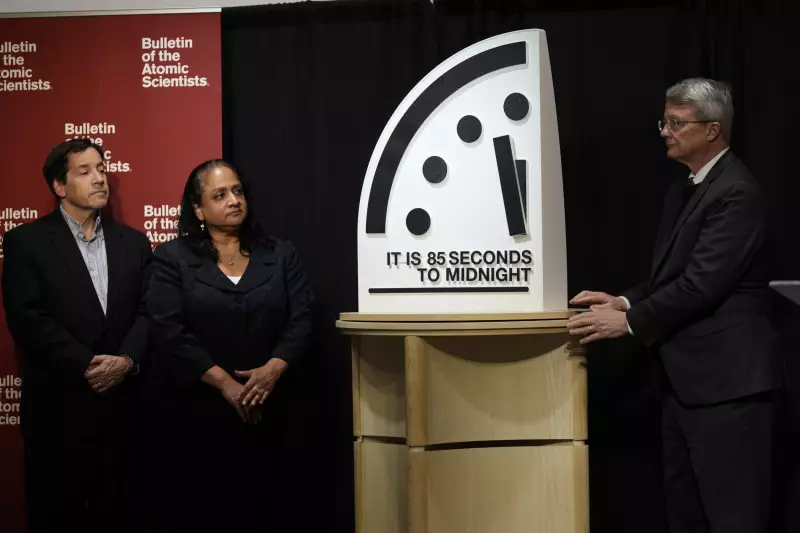
Doomsday Clock Advances to 85 Seconds to Midnight in Grave Global Warning
The Doomsday Clock has been moved four seconds closer to midnight, signaling that humanity is now a mere 85 seconds away from potential global catastrophe. This alarming adjustment was announced by the Bulletin of the Atomic Scientists during a briefing in Washington DC, marking the closest the symbolic clock has ever been to midnight since its inception in 1947.
Unprecedented Global Risks Drive the Shift
The decision to advance the clock reflects a stark assessment of escalating existential threats facing the world. According to the Bulletin, the primary factors include:
- Heightened nuclear conflict risks, with aggressive states expanding their reliance on nuclear weapons
- Climate change intensifying through continued fossil fuel dependence and extreme weather events
- Emerging technologies, particularly unregulated artificial intelligence systems
- Geopolitical instability across multiple conflict zones
Alexandra Bell, president and chief executive officer of the Bulletin of the Atomic Scientists, emphasized the urgency of the situation, stating: "Every second counts and we are running out of time. It's a hard truth, but this is our reality." She noted that world leaders have failed to take sufficient action to reduce these existential threats.
Historical Context and Recent Trends
The Doomsday Clock has been steadily approaching midnight in recent years. It was set at 90 seconds to midnight in 2023 and 89 seconds in 2025. This represents a dramatic shift from the most optimistic setting in history - 17 minutes to midnight in 1991 following Cold War-era nuclear reduction agreements between the United States and the Soviet Union.
Board member John Wolfsthal described this year's decision as "unusually clear-cut," while Bell added that "2025 has been a pretty bleak picture in terms of advancing existential risks."
Specific Threats Highlighted by Experts
The Bulletin identified several concrete developments contributing to the increased danger:
- Geopolitical tensions including Iran's warnings of "all-out war" if attacked by the United States, ongoing protests and crackdowns in Iran, Israel's war in Gaza, and Russia's prolonged invasion of Ukraine now entering its fourth year
- Nuclear escalation risks with the Bulletin warning that a single miscalculation or accident could transform existing conflicts into nuclear confrontations
- Artificial intelligence threats highlighted by Steve Fetter of the Bulletin's Science and Security Board, who warned that new AI tools "pose a threat to the survival of humanity" through capabilities like generating convincing fake videos of riots or acts of war
- Climate impacts including wildfires in California, deadly heatwaves in Europe, and powerful hurricanes like the one that struck Jamaica last year
- Biological threats such as COVID-19, bird flu, and inadequate global pandemic responses
The Clock's Purpose and Implications
First introduced in 1947, the Doomsday Clock serves as a powerful warning to both the public and policymakers about the consequences of failing to address the world's most serious threats. When the symbolic clock reaches midnight, it signifies that humanity has failed to avert global disaster scenarios including nuclear war or irreversible environmental collapse.
The Bulletin's latest assessment presents a sobering picture of a world where multiple crises are converging simultaneously, creating what experts describe as the most dangerous period in human history. The organization continues to call for immediate, coordinated international action to pull humanity back from the brink.