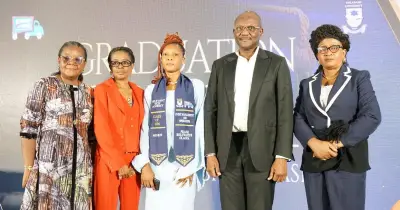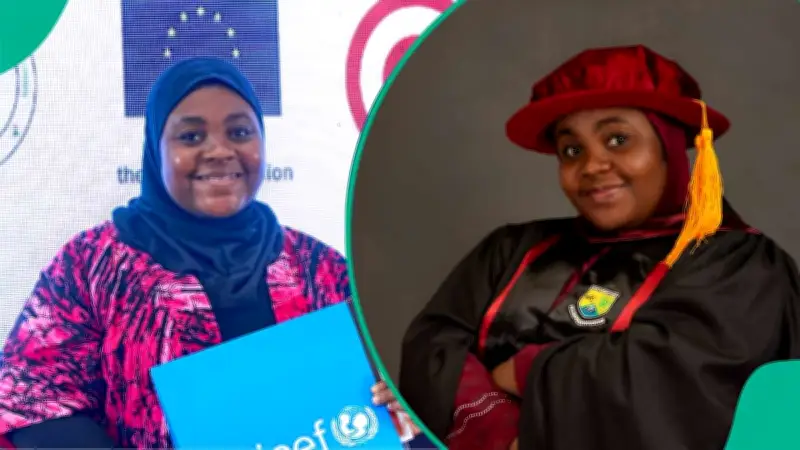
Shamsiyyah Umar, a 28-year-old disability rights advocate from Nasarawa State, completed her PhD in International Relations at age 27, earning all three of her academic degrees before turning 30 while managing a physical disability and running her own foundation, We Are Special Foundation.
Academic Milestones and Background
Umar began her academic journey at Ahmadu Bello University, Zaria, where she studied International Studies for her undergraduate degree between 2015 and 2019, graduating with a CGPA of 3.99. She returned to the same institution for her Master's in International Affairs and Diplomacy from 2021 to 2022, finishing with a CGPA of 4.08. Her PhD at Nasarawa State University, Keffi, focused on UNICEF's contribution to inclusive education for children with disabilities in Nigeria between 2015 and 2023.
Born and raised in Karu, Abuja, Umar comes from a family she describes with warmth and a touch of humour. Her mother had two sets of twins, making Shamsiyyah, who has a twin brother, the youngest among five siblings. International Relations was never her original plan. During her final year of secondary school, a classmate mentioned the course in passing, and she applied almost on impulse. Umar told Legit.ng: "Interestingly, I had always wanted to study Law. I still joke that perhaps I will eventually go back and get a law degree. International Relations was actually a last-minute decision. During SS3, one of my classmates mentioned the course to me and I thought it sounded interesting. Somehow, I applied for it almost with my eyes closed, without fully knowing what I was getting myself into. But once I started studying International Studies, I fell in love with the course."
Disability and Personal Loss
At 10 years old, Umar was struck by a car on Christmas Day, driven by a 17-year-old boy who had taken his father's vehicle without permission. The accident left her with a physical disability that has shaped both her personal life and her professional direction, as she relies on a walking aid for movement. She told Legit.ng: "Growing up with a disability has meant experiencing many of the challenges that persons with disabilities face, including accessibility barriers, stigma and misconceptions. It has also affected different aspects of my life and relationships. But I have been incredibly fortunate to have a loving and supportive family. My late mother, in particular, played a major role in helping me see beyond my disability. She never allowed me to believe that my disability was the limit of what I could achieve."
Her late mother, who passed away just months after she enrolled for her PhD, was her greatest source of motivation. Umar recalled: "My biggest motivation has always been my late mother. She passed away just a few months after I enrolled for my PhD, and that made the journey even more emotional for me. My mother loved education. She loved the fact that I enjoyed studying and was always one of my strongest supporters. I wanted to make her proud. So, whenever things became difficult during my PhD, I reminded myself of her. There were days when I was exhausted and frustrated, but I kept going because I knew how much she believed in me."
Challenges and Advocacy Work
Navigating university as a person with a disability presented real and constant obstacles. Classrooms and offices that were accessible only by staircase made her daily academic life more physically demanding than it was for her peers. She told Legit.ng: "The two biggest challenges were accessibility and stigma. Accessibility was a constant issue. There were classrooms, offices and other university facilities that were difficult to access, particularly when activities or meetings were held upstairs. During my first year especially, I felt like I was constantly trying to navigate the system and find my place. I was trying to prove that I belonged while also dealing with barriers that other students did not have to think about. But over time, I learned to advocate for myself. I also became more confident in demanding the accommodations and access I needed."
Running her organisation, We Are Special Foundation, alongside her studies added another layer of pressure. The foundation works to promote inclusion and expand opportunities for persons with disabilities. Despite the weight of balancing advocacy, leadership and research, she remained consistent. Sharing her goals, Umar said: "A major part of my work will continue to focus on disability inclusion. I am currently building an accessible technology platform under the AU-EU Youth Action Lab through my organisation. The goal is to create a platform that connects persons with disabilities to opportunities, learning, mentorship and other important services. So, my personal and professional goals are closely connected. I want to continue building solutions, advocating for inclusion and using technology to make opportunities more accessible to persons with disabilities. I want my work to show that disability should never be a barrier to education, leadership, technology or achieving one's dreams."