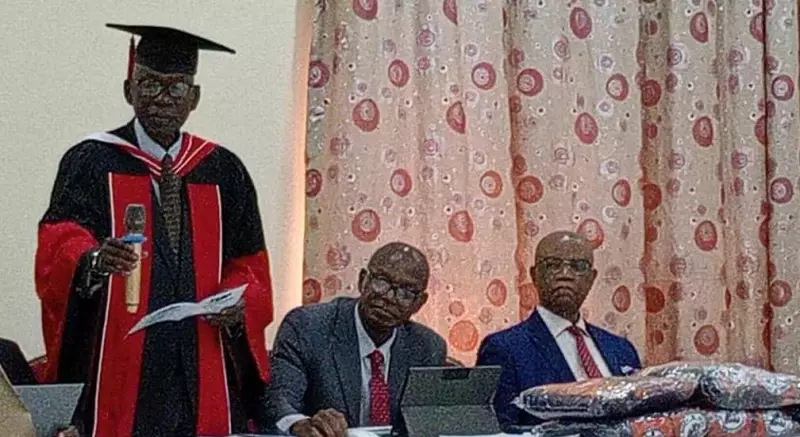
The Social Science Academy of Nigeria (SSAN) has issued a strong call to the Nigerian government, urging the immediate and increased deployment of competent social scientists into national planning and policymaking roles. The Academy argues that the country's multifaceted crises cannot be resolved without the critical input of these experts.
A Call for Evidence-Based Solutions Over Political Assumptions
Speaking at the opening of the Academy’s 2025 General Assembly in Abuja, the President of SSAN, Prof. Chike F. Okolocha, stated that Nigeria possesses a wealth of capable social scientists. He emphasized that these professionals are trained to understand human behavior, institutions, and development dynamics, which is essential for crafting effective solutions.
Prof. Okolocha warned that the nation's deepening social, economic, and security challenges require evidence-based solutions rather than politically driven assumptions. He criticized a growing anti-intellectual posture within government, marked by policy inconsistencies and public statements not backed by facts.
“Nigeria has competent social scientists who can see beyond narrow political constrictions to formulate genuine evidence-based policy options to change the country for the better,” he asserted.
Historical Policy Missteps and Current Concerns
The SSAN President highlighted several historical and recent policy decisions made without expert consultation, labeling them as detrimental to national development. Key examples he cited include:
- The 1982 removal of History from the school curriculum, a decision he said lacked evidential basis and took 35 years to reverse, causing immense tangible and intangible losses.
- The 2019 claim by a former labour minister that Nigeria had “too many doctors.”
- The 2025 declaration by the Minister of Education that the country had “too many social scientists” and should discontinue related university courses. Okolocha countered this, stating, “if we are to reverse gross civic incompetence and irresponsibility, Nigeria needs to produce more (competent) social scientists.”
He also faulted the recent reversal of the National Language Policy (NLP), which promoted mother-tongue instruction in early education. Developed after a decade of expert input, he noted the policy was praised and adopted by other African nations, and its rollback threatens cultural preservation.
Systemic Barriers to Knowledge and Development
Prof. Okolocha expressed deep concern over the persistent instability in Nigerian universities, fueled by the long-standing conflict between the government and the Academic Staff Union of Universities (ASUU). He described recurring strikes and poor funding as major barriers to knowledge production and innovation.
“It is disheartening that ASUU went on strike again this year over the same issues that have remained unresolved for fifty years,” he lamented.
Furthermore, he questioned the logic of continuously establishing new universities amidst a shortage of qualified candidates, pointing out that falling admission cut-off marks contradict official claims of an excess of qualified students. “The cry over falling standards in education will continue as long as we continue flooding the universities... with unqualified candidates,” he warned.
In a keynote address, Dr. Adam Okene Ahmed, a Professor of Security History & International Studies, analyzed Nigeria's trajectory from 1990 to 2020 as a paradox. He described it as a formal transition to civilian rule persistently constrained by authoritarian legacies, defining Nigeria's transformation as fundamentally unfinished.
The SSAN's mandate is to interrogate national issues and contribute knowledge to policymaking. The Academy's leadership insists that this role is now more critical than ever for navigating Nigeria's complex challenges towards sustainable development.