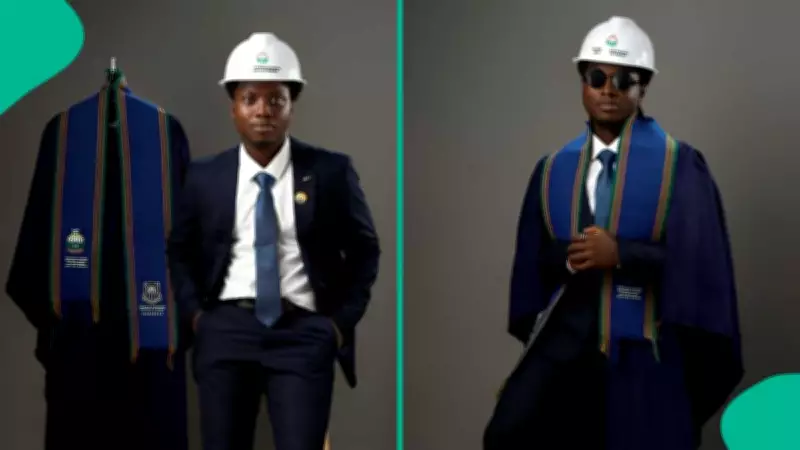
University of Ibadan Engineering Graduate Charts Creative Path After Six-Year Academic Journey
A recent graduate from Nigeria's prestigious University of Ibadan has shared his unconventional career plans following the completion of his Industrial and Production Engineering degree after six years of study. Akorede Adekunle, who documented his academic journey on LinkedIn, revealed how he intends to bridge the gap between engineering principles and creative fields.
From Engineering Fundamentals to Creative Applications
In a detailed LinkedIn post that has garnered significant attention, Adekunle reflected on his transformative six-year experience at Nigeria's premier university. "Six years ago, I walked into the University of Ibadan, the first and the best, as an Industrial and Production Engineering student," he wrote. "Today, I'm walking out with a degree, amazing memories, and a story I'm really proud of."
The graduate emphasized that his time at the institution provided more than just academic knowledge. He highlighted the opportunity to meet inspiring friends, interact with brilliant minds, and develop critical thinking skills that extend beyond traditional engineering applications.
Curiosity Leads to Additional Skill Development
During his engineering studies, Adekunle's curiosity pushed him to explore interests beyond his core curriculum. This exploration led him to complete comprehensive courses in UI/UX design and digital marketing, areas that initially began as supplementary learning but quickly evolved into genuine passions.
"Somewhere along the way, curiosity kicked in," Adekunle explained. "I started exploring other interests and ended up completing courses in UI/UX Design and Digital Marketing. What began as 'just learning something new' quickly turned into a real passion for brand identity and creative design."
Engineering Principles Applied to Creative Fields
Addressing the inevitable question about his career direction with an engineering degree, Adekunle presented a compelling argument for the transferability of engineering skills to creative industries. He emphasized that Industrial and Production Engineering focuses fundamentally on systems, efficiency, problem-solving, and designing better processes—concepts he believes are equally crucial in design and branding.
"My answer is simple," Adekunle stated. "Industrial and Production Engineering is about systems, efficiency, problem-solving, and designing better processes. In many ways, great brands are built the same way."
The graduate elaborated on this connection, noting: "Good design isn't just about making things look nice. It's about structure, clarity, functionality, and experience—the same principles engineers use when designing systems. So whether it's optimizing a production line or building a brand identity, the goal is still the same: create something that works beautifully and delivers real value."
Holistic University Experience Beyond Academics
Adekunle's university journey wasn't limited to classroom learning and skill development. He actively participated in sports during his time at the University of Ibadan, demonstrating a well-rounded approach to his educational experience. This balanced perspective appears to have informed his current outlook on career possibilities.
Reflecting on his integrated learning approach, Adekunle summarized: "Engineering trained my mind to solve problems. Design gave me a canvas to apply it creatively." This synthesis of technical and creative training represents an emerging trend among Nigerian graduates who are increasingly seeking to apply their formal education in innovative, cross-disciplinary ways.
The graduate's story comes at a time when Nigerian universities are producing increasingly versatile graduates who combine traditional degrees with contemporary digital skills. Adekunle's journey from Industrial and Production Engineering to brand identity and creative design illustrates how Nigerian graduates are redefining career paths in an evolving economic landscape.