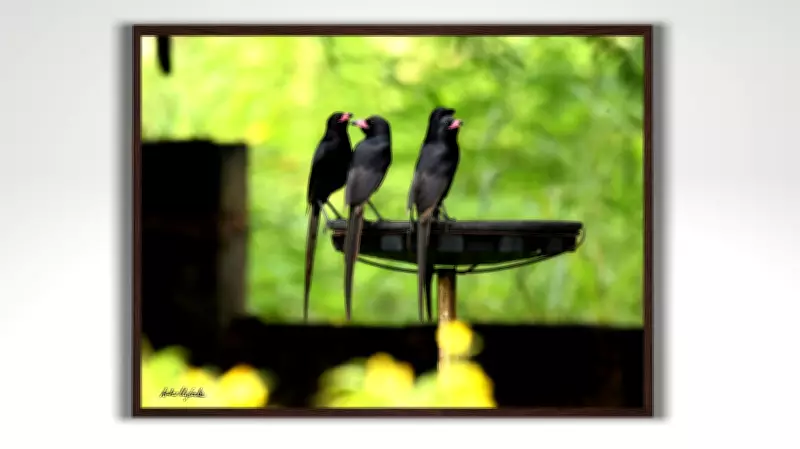
Aako Ugbabe, an engineer and physicist with interests in astrophysics and philosophy, presents his exhibition 'Wild Meets Urban' at the Didi Museum on Akin Adesola Street, Victoria Island, Lagos. The show concludes today. Ugbabe draws on his long-standing passion for nature walks and bird watching to capture a metaphor that binds the country, from the southern wetlands to the northern plateaus.
Nature Through His Lens
Ugbabe interrogates the movements of objects on earth, concluding that while the lens captures a moment, the heart captures the connection between objects. To protect biodiversity, humanity must learn to protect one another. The architects—insects and spiders weaving intricate geometric wonders; the survivors—wildflowers and grasses blooming in unexpected places; the navigators—birds traversing skies oblivious to borders—all prove that nature was not made for man; humans are of nature.
Watching seagulls gave him insight into bird flight aerodynamics, the subject of his new show. The images capture birds in their natural habitat, insects, butterflies, wildflowers, and people engaged in daily activities frozen in time. This exhibition is not merely a collection of photographs; it interrogates the connectivity between biodiversity and community, offering a visual testimony of the deep-seated relationship between humans and their environments.
Interconnectedness of Life
Ugbabe notes that whether it is a woman on her way to the local market or the stillness of a city under a vast Sahelian sky, these images remind us that our identities are not separate from the land—they are birthed from it. Beyond grand vistas, the photographs invite viewers to consider salient issues such as religion, status, and orientation. Though often used to divide humanity, they whisper simple truths: 'If we cannot master the art of living together in peace, we cannot hope to protect the nature that sustains us,' Ugbabe admonishes.
As visitors walk through the room, the images remind them that the butterfly in the garden, the child in the village, and the grass in the field are all interconnected. In his curatorial statement, Moses Ohiomokhare says that although trained as a scientist, Ugbabe approaches photography with the sensibility of a cultural observer and storyteller. His practice demonstrates how disciplines can intersect to produce a thoughtful visual language combining analytical attention with poetic sight.
Intersection of Documentation and Art
Ohiomokhare continues that Ugbabe's body of work sits at the intersection of documentation and artistic mediation, inviting viewers into a visual narrative shaped by memory, identity, and lived experience. Through his lens, landscapes, communities, and everyday encounters are transformed into images that speak about place, belonging, and the passage of time.
Jos is the heart of the interrogation, and the photographs move to find perfect explanation there. Ugbabe explains that the works are a product of the COVID-19 lockdown, when reduced human activities allowed birds and other creatures to incursion into human territories, questioning what might have happened. Thus, the wild came to meet the urban.
Rare Species and Human Encounters
In one untitled work, Ugbabe's lens captures the Narina's Trogon, a very rare species in this part of the world, sitting on a tree in his compound. In another, he captures women on their way to ply their trade of fura da nono, kindirimu, and man shanu. Emerging from their ruga, resplendent in their clothes, they ran when a photograph was about to be taken. These women represent the dichotomy between the wild and urban: they live in the wild in their ruga, tend cattle, and pound millet for fura. Ugbabe says, 'I want to take pictures but they take off and run, or hide their faces, or are resigned to the fact that I had already clicked the shutter.'
According to Abraham Onoriode Oghobase, nature sits at the heart of Ugbabe's practice. It offers him a rhythm of slowness, opening space for chance encounters—those fleeting, fragile moments that often pass unnoticed. Oghobase adds that there is a distinct joy in the way Ugbabe shares stories of these encounters, a quiet excitement that reveals an awakening. Through photography, one senses the reemergence of a creative impulse perhaps long held in abeyance.
Scientific Curiosity and Poetic Sensitivity
Oghobase reveals that Ugbabe's particular fascination with documenting birds across the landscapes of Jos and Otukpo speaks to both scientific curiosity and poetic sensitivity. Ugbabe was born on October 16, 1949. He graduated with a first-class honors degree in electrical engineering from Ahmadu Bello University and earned a Ph.D. in atomic physics from Flinders University, Adelaide. Alongside his art and humanitarian pursuits, Ugbabe is engaged in building a gallery and cultural center, Padma Arts, as a legacy project to encourage all forms of artistic pursuits: music, photography, poetry, theatre, and others.