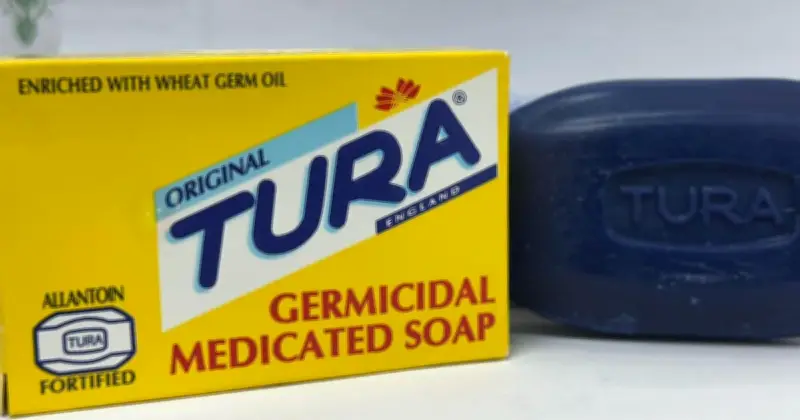
No, Tura Medicated Soap is not a skin-bleaching product, according to its available ingredient information. The soap lists triclosan, vitamin E, allantoin, and glycerine among its ingredients, with no mercury or hydroquinone listed. NAFDAC records also classify Tura Germicidal Medicated Soap as a germicidal medicated soap, not a bleaching agent.
Why the Confusion Exists
The confusion partly stems from words such as “clearer,” “toned,” or “more even-looking” that appear in some online descriptions of the product. These terms can sound like claims about altering natural skin colour, but cleansing, improving the appearance of blemishes, and bleaching the skin are distinct actions. Tura Medicated Soap is positioned as a germicidal medicated soap, with 0.28% triclosan as its antibacterial ingredient, alongside vitamin E, allantoin, and glycerine.
Skin bleaching, in contrast, refers to the use of substances intended to reduce or alter melanin production, which gives skin its natural colour. Hydroquinone, mercury compounds, and certain corticosteroids are among substances associated with skin-lightening products. NAFDAC's regulations prohibit cosmetics containing listed skin-bleaching agents and place restrictions on hydroquinone above specified limits.

How to Read a Soap Label Yourself
If you want to determine whether a soap contains hydroquinone, start with the ingredient list rather than marketing language. Look for hydroquinone, sometimes abbreviated as HQ. For mercury, names can include mercurous chloride, calomel, mercuric, or mercurio. For corticosteroids, ingredients such as betamethasone and clobetasol deserve attention.
Be cautious if a product has no ingredient list, no identifiable manufacturer address, or no NAFDAC registration information. Be equally cautious about promises that your skin will become dramatically lighter in just a few days. NAFDAC's Greenbook provides a searchable database of registered products, ingredients, registration numbers, and approval information. Checking the packaging against the database is more reliable than relying on online claims.
What Tura's Ingredients Actually Do
Tura's ingredient information lists triclosan as the antibacterial ingredient, alongside vitamin E, allantoin, and glycerine. Triclosan gives the soap its antibacterial function, while the other listed ingredients form part of the cleansing and conditioning formulation. This helps explain why some users may describe their skin as looking fresher or clearer after use. Regular cleansing can remove sweat, oil, and surface impurities, while reducing bacteria can be relevant to concerns such as body odour and spots—this is different from deliberately suppressing melanin production.
If you are shopping for Tura Medicated Soap from The Diva Shop, check the packaging and ingredient information of the product you receive, particularly if you are comparing it with an older version or buying from an unfamiliar seller. The key point is simple: a clearer-looking complexion is not automatically a lighter complexion.
If You Are Trying to Even Out Your Skin Tone
If uneven pigmentation is your concern, separate the goal from the method. Dark spots can have different causes, including previous inflammation, acne, irritation, and sun exposure. Addressing the underlying cause and protecting the skin from further irritation can be more useful than immediately reaching for a product marketed as a bleaching or whitening solution. A conventional medicated cleansing bar should not be assumed to alter your baseline pigmentation simply because your skin looks cleaner or more even after washing.
Likewise, if you are wondering whether Tura soap removes dark spots, it is better not to treat the soap as a dedicated pigmentation treatment. Tura is a medicated cleansing product. Persistent or stubborn hyperpigmentation is better assessed by a dermatologist, particularly when the cause is unclear.
Frequently Asked Questions
Does Tura soap contain hydroquinone? The available ingredient information for Tura Medicated Soap lists triclosan, vitamin E, allantoin, glycerine, and other soap ingredients, but does not contain hydroquinone. NAFDAC's regulations restrict hydroquinone in cosmetics above specified limits.

What is the difference between a toning soap and a bleaching soap? “Toning” and “bleaching” are often used loosely in product marketing, so the words alone do not tell you what a product does. Bleaching involves substances intended to reduce or alter melanin production, while cleansing may simply improve the appearance of skin without changing its natural pigmentation.
Can a soap change your natural skin colour? A cleansing soap can make skin appear fresher, cleaner, or more even by removing surface oil and build-up. That is not the same as changing natural pigmentation. A product containing bleaching agents can affect melanin, however, which is why checking the ingredient list is important.
Conclusion
The simplest way to answer whether Tura soap bleaches the skin is to look at what the product is formulated to do and what its ingredient information actually lists. Tura Medicated Soap is a medicated soap containing triclosan, vitamin E, allantoin, and glycerine, and it does not contain mercury or hydroquinone. If your concern is an uneven complexion, dark spots, or a sudden change in skin colour, focus on identifying the cause rather than assuming that every “clearer” or “toned” result means bleaching. When pigmentation persists, a dermatologist can help determine what is actually causing it.