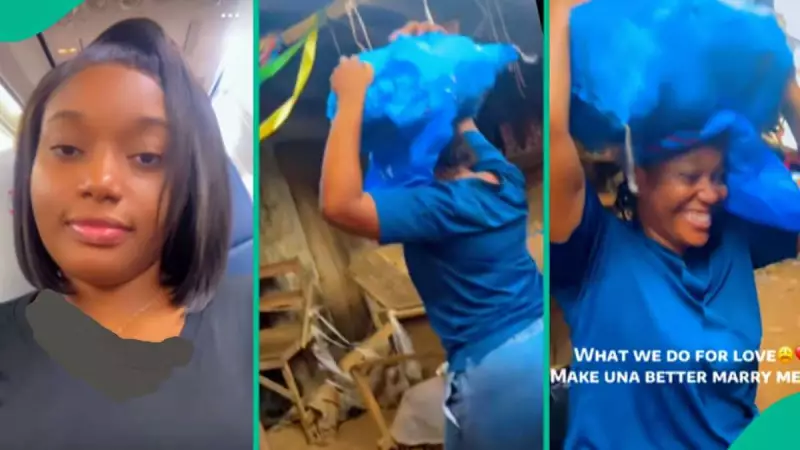
A recent trip to her boyfriend's ancestral home has turned a Nigerian lady into an online sensation, sparking widespread discussion about love, cultural duties, and the path to marriage. The lady, who shared her experience on TikTok, found herself at the centre of a social media debate after accompanying her partner's mother to a local market.
A Trip to the Village and a Trip to the Market
The story unfolded when the lady, identified on TikTok as @degeorgeempire3, travelled with her boyfriend to his village. During the visit, her boyfriend's mother invited her to accompany her to the market. The lady documented the experience in a now-viral video.
In the clip, she is seen actively participating in the market errands, even carrying purchased goods on her head while the older woman walked behind her. After completing the tasks, the lady addressed the camera with a mix of humour and hopeful expectation. She publicly appealed to her boyfriend and his family, saying, "What we do for love. Make una better marry me o," expressing her desire for the relationship to culminate in marriage after her efforts.
Netizens Divided: Cultural Bonding or Exploitation?
The video, posted on January 8, 2026, quickly flooded with comments as Nigerians shared sharply contrasting views on the lady's actions. The reaction highlights a generational and ideological split regarding modern courtship and family integration.
One faction saw her willingness to help as a positive and traditional step. User @Buzor defended her, stating, "What is wrong in helping out your potential mother in-law to shop for items? It's even a way of bonding. Let's not see everything from a negative angle." Another commenter, @Mmilibuaku, suggested that the mother's request was itself a sign of acceptance: "Parents don't ask friends of their children help or send them errand, if they don't like them."
However, a significant number of viewers criticised the situation, labelling it as premature or even exploitative. User @Chinenyeokeke pointedly asked, "What are you doing in a village where ur bf family has not come to pay ur bride price or married u sef?" This sentiment reflects a traditional perspective that such deep family involvement should follow formal marital procedures.
Others warned against over-investment without commitment. User @Val shared a cautionary tale based on personal experience: "I no do all ds one but him still pay my pride price... all I got was regret n maltreatment, abeg ladies ds is 2026 sey boundaries n stop d desperation or doing too much."
Beyond a Single Video: A Reflection of Modern Dating
This incident is not an isolated online moment but taps into a recurring theme in Nigerian social media discourse. It echoes previous stories, like one reported by Legit.ng where a lady cleaned her prospective in-laws' entire kitchen, which also drew mixed reactions.
The debate revolves around core questions: How much should one do to prove commitment before marriage? What is the line between respectful cultural integration and losing one's boundaries? Is helping with domestic chores a genuine way to build bonds with a potential new family, or an outdated test?
The lady's playful yet earnest plea for marriage at the end of her video underscores the underlying hope that such efforts will be recognised and rewarded with a lasting commitment. Whether her actions will lead to the desired outcome remains a private matter, but the public conversation she ignited continues to examine the evolving landscape of love, tradition, and marriage in contemporary Nigeria.