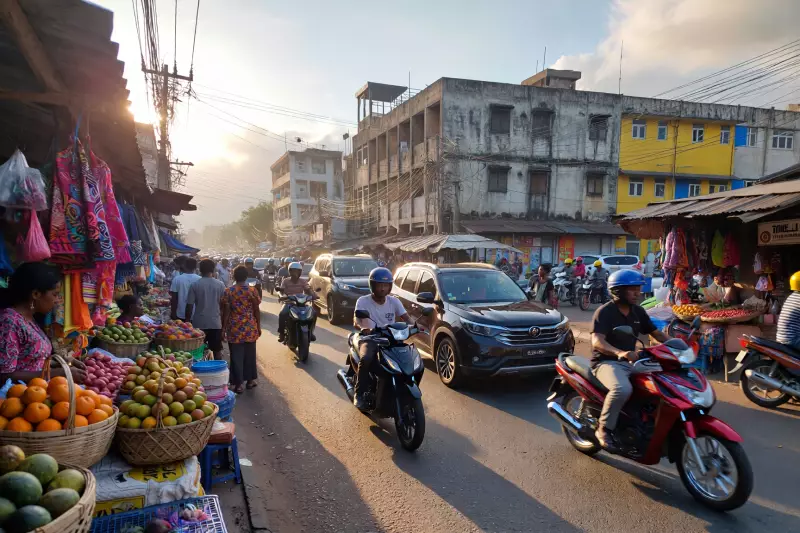
Understanding contemporary Nigeria demands moving beyond simple headlines to grasp the intricate, often contradictory realities faced by its over 230 million citizens. Based on extensive research and travel across the nation, from Lagos's tech hubs to the ancient cities of the North, a clear picture emerges: life here is defined by profound economic hardship, yet sustained by an equally profound resilience and vibrant social fabric.
The Daily Grind: Navigating Costs and Infrastructure Failures
Daily living conditions in Nigeria present a stark challenge, heavily influenced by location and income. In the commercial capital, Lagos, a one-bedroom apartment in a decent area can command a staggering ₦800,000 to ₦2 million monthly in rent. This same amount could secure an entire house in many Northern cities, highlighting dramatic geographic disparities.
For the average worker, these costs are crippling. Consider a civil servant earning ₦150,000 monthly, who must allocate ₦600,000 annually for rent. After accounting for transport (₦40,000 monthly) and food (₦70,000), little remains for other essentials like school fees, creating a perpetual cycle of financial strain.
Infrastructure failures compound these economic pressures. Reliable electricity remains a luxury, with most Nigerians receiving fewer than 12 hours of power daily, and many areas limited to just 4-6 hours. This forces households and businesses to spend enormous sums on generators and fuel, which now costs over ₦1,000 per litre.
Access to clean water is another daily struggle. Unreliable municipal supply pushes middle-class families to spend ₦15,000 to ₦30,000 monthly on water from tanker trucks. The healthcare system is sharply divided: the wealthy seek treatment abroad, the middle class pays ₦50,000 for private doctor consultations, and the poor endure underfunded public hospitals.
Education costs have also skyrocketed, with decent private primary schools in Lagos charging ₦300,000 to ₦1 million annually per child. Public schools, while cheaper, often lack basic facilities and trained teachers, placing immense pressure on families.
Converging Crises: Economic and Security Pressures
Nigeria is currently grappling with simultaneous economic, security, and governance crises that feed into each other. The economic situation deteriorated sharply following the fuel subsidy removal in May 2023, triggering inflation that peaked above 30% and a naira that collapsed from ₦450 to over ₦1,750 per US dollar.
This has decimated purchasing power. A teacher in Kano, whose salary of ₦95,000 provided comfort in 2022, now finds the same amount barely covers food, as a bag of rice soared from ₦25,000 to ₦95,000. Food inflation exceeded 40% in 2024, creating a severe affordability crisis for millions.
Security concerns cast a long shadow, varying by region but affecting national psyche. The Northeast continues to battle Boko Haram insurgency, while the Northwest faces rampant banditry and kidnapping. The Southeast deals with separatist tensions and attacks by unknown gunmen. This climate of fear has made risk assessment a routine part of daily planning for many Nigerians.
According to reports, approximately 133 million Nigerians live in multidimensional poverty, experiencing deprivations in health, education, living standards, work, and security all at once. Corruption acts as an additional tax, with unofficial payments required for many basic services, making everything more expensive and demoralizing.
Regional Disparities and the Resilience Factor
The Nigerian experience is not monolithic. A snapshot of living standards reveals deep regional inequalities. The South-West, particularly Lagos, sees higher average incomes (₦120,000-₦180,000 monthly) and better electricity (8-12 hours daily) but faces high food costs and traffic woes. In contrast, the North-East, around Maiduguri, contends with much lower incomes (₦65,000-₦100,000), severe power shortages (3-6 hours daily), and the primary security threat of insurgency.
Despite these daunting challenges, Nigeria pulses with an undeniable energy. This resilience manifests in several key areas. The nation's food culture is exceptional, providing joy and a sense of shared identity. Social connections run deep, with family and community networks offering crucial support systems absent from government.
Cultural output is world-class, from Nollywood's prolific film production to the global dominance of Afrobeats. Most critically, an unmatched entrepreneurial spirit thrives. Faced with systemic failures, Nigerians constantly innovate—generator markets, water delivery services, and ubiquitous motorcycle taxis (okadas) are all testaments to this adaptive hustle.
For the wealthy elite (roughly 5-10% of the population), life can be comfortable, insulated by private estates, generators, and international schools. For the struggling middle class, it is a constant hustle to avoid sliding backward. For the majority living in poverty, it is a daily battle for survival. Yet, across all strata, a communal spirit and determined optimism persist, creating a quality of life that stark statistics alone cannot capture.
The verdict on life in Nigeria today is necessarily dual. It is characterized by severe economic hardship, persistent infrastructure deficits, and genuine security concerns. Yet, it is equally defined by vibrant cultural expression, deep social bonds, and a remarkable capacity to adapt and endure. To understand Nigeria is to hold both these truths simultaneously.