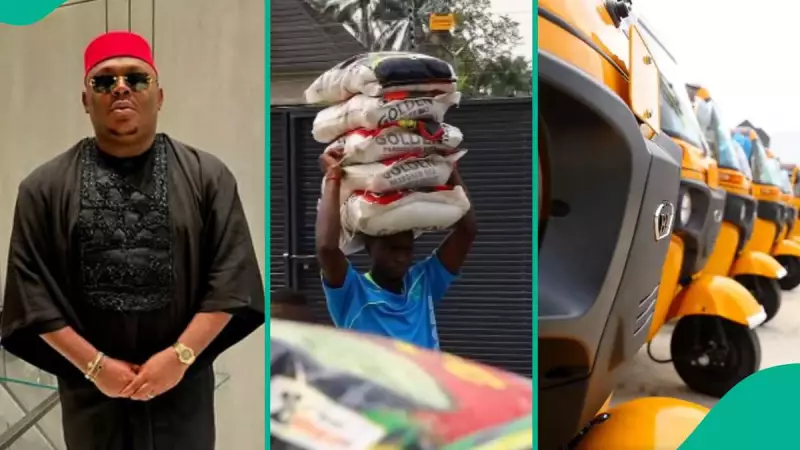
In a remarkable display of generosity that has captured the hearts of Nigerians online, a businessman has continued his long-standing tradition of transforming lives in his hometown during the festive season. Francis Nwaogwugu Udochukwu, the CEO of Vintage Deluxe Interiors, went far beyond the usual holiday gifts, empowering his community with significant items that foster economic independence.
A Tradition of Giving That Grew Exponentially
The heartwarming initiative, shared in a video on his Instagram, is not a one-off act of kindness. Udochukwu revealed that he began this philanthropic journey fourteen years ago, in 2014, with a simple act of sharing rice twice annually. Over the years, the program has expanded in both scale and impact. This year, the empowerment reached a monumental scale, with the businessman estimating the total value at a staggering 200 million naira.
"I wish I can do more. Seeing these smiles on the faces of my people gives me joy," Udochukwu expressed. "I started this 14 years ago with just rice sharing twice every year. It gets better and bigger every year, this year we did 200m empowerment and it can only be God."
Beyond Food: Tools for Sustainable Livelihoods
What sets this Christmas giveaway apart is its focus on sustainable empowerment. While bags of rice and cash were distributed to many, the cornerstone of the event was the provision of income-generating equipment. The beneficiaries received:
- Tricycles (Keke NAPEP) for transportation business.
- Motorcycles for mobility and commercial use.
- Sewing machines for tailoring and fashion ventures.
- Grinding machines for food processing businesses.
This strategic approach moves beyond temporary relief, offering villagers the tangible means to create and sustain their own sources of income long after the Christmas celebrations have ended.
Social Media Erupts with Praise and Reflection
The online reaction to Udochukwu's generosity was swift and overwhelmingly positive, sparking conversations about community support and governance.
User @scjerry_1 commented, "Things like this are very relevant because the government has absolutely failed the country. Imagine someone smiling for the first time of the year in December when the year is about to end." This sentiment highlights how such private acts of charity fill a perceived gap in public welfare.
Others, like @MaryjaneHeight1, focused on the virtue of giving: "What’s the essence of money if not this. God bless you big brother. You will keep going higher and doing greater." The act was also seen as emblematic of the communal spirit in Nigeria's South-East region, with @eebuchi noting, "Good stuff, Vintage Ndi Mbaise nwere mmadu ebea! Imo state doings unrivalled!"
Some reactions, however, offered constructive ideas for the future. User @nonsookongwu1 suggested, "This is good, I love it. But it ll be more productive if there is a system of accountability... instead of giving out electric sewing machines to individuals, you can collaborate all of them into one business center." This points to a potential evolution from individual empowerment to collective enterprise development.
A Broader Culture of Festive Season Generosity
Udochukwu's story is part of a wider tradition during the Christmas period in Nigeria, where successful individuals often return to their ancestral communities to give back. The report references a similar incident where another man was praised for providing cows and bags of rice to his community. These acts reinforce the strong cultural ties to home and the importance of sharing success, making the festive season a highly anticipated time for communal support and celebration across many regions.
The enduring legacy of Francis Nwaogwugu Udochukwu's 14-year commitment demonstrates how consistent, thoughtful philanthropy can become a powerful engine for local economic development and hope.