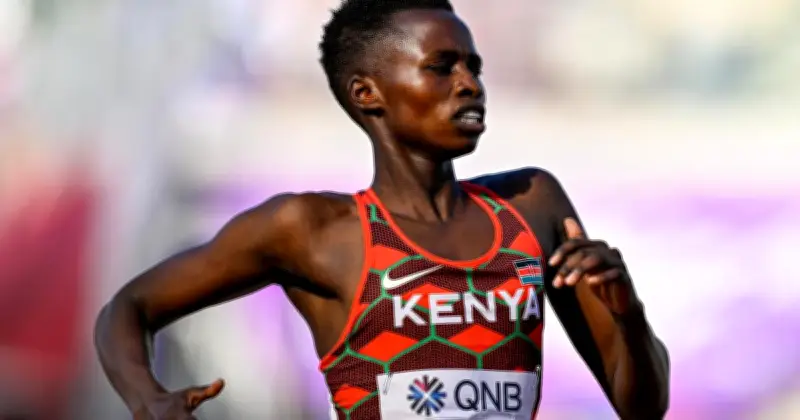
Kenyan middle-distance runner Naomi Korir, who lived with congenital fistula for 13 years, has become a Commonwealth Games finalist and a global inspiration after undergoing three surgeries and rebuilding her life and career.
A Childhood Marked by a Debilitating Condition
Before Naomi Korir became a Kenyan athlete competing on some of the biggest stages in the world, she was a young girl trying to find a way to keep doing what she loved while dealing with a condition that made everyday life difficult. The 28-year-old athlete was born with congenital fistula, a condition that caused uncontrolled urine leakage and affected her confidence, training, and early dreams of becoming a professional runner.
Growing up, Korir was the kind of child who wanted to participate in every sport available. She played football, netball, athletics, and even rugby. But while she loved competition, her health condition made training extremely difficult.
"I played most of the sports activities: football, netball, athletics, even rugby," she said. However, the reality of living with fistula affected her ability to train comfortably. "But it was difficult because [of] the training, and the urine is flowing continuously. It's bad."
Adjusting Her Running to Cope with the Condition
Because of the leaking, Korir had to change her approach to athletics. "I reduced my running to shorter distances to reduce the leaking." She eventually moved into the 100m hurdles as she tried to continue participating in sports. Still, athletics became more than just a hobby. It gave her confidence and helped her deal with the loneliness that came with her condition.
"I could do it because I loved it," she said. She added: "Because most of the people could avoid me, I did a lot of activities just to pass time and not to feel that I'm excluded."
Korir lived with fistula for 13 years before finally getting the treatment that changed her life. She was born with genitourinary tract fistula, an abnormal connection between the bladder and vagina that caused urine leakage. Her first two surgeries did not solve the problem, but in August 2013, a third operation at Gynocare Hospital in Eldoret, Kenya, finally brought relief when she was 13 years old.
Gynocare's Role in Her Recovery
The hospital’s director, Caroline Mabeya, explained that fistula often affects more than just a person’s physical health. "It's a difficult condition to live with every day," she said. She added that many women living with the condition face rejection and isolation. "They are ostracised in the society. That's the psychological torture that they face with the fistula."
Gynocare also supports women after treatment by helping them rebuild their confidence and return to normal life. Mabeya said: "We offer free treatment for these women at Gynocare because most of them are very poor." She explained: "When they come into the facility, they are crushed, they have low esteem. So, there's a huge amount of effort that is put in to make them at least be strong enough to be reintegrated and get back into the community."
From Patient to Professional Athlete
Naomi Korir had competed for Kenya in major international athletics events, including the World Championships and Commonwealth Games. After her successful surgery, Korir got a fresh opportunity — both academically and athletically. Through Gynocare’s Beyond Fistula programme, she continued her education and completed secondary school. "I have a family in GynoCare, a fistula home. That is where I schooled after my surgery until I finished my secondary level."
Her athletics career began professionally in 2019, and she quickly started making progress. In 2021, Korir won a silver medal in the mixed 2x2x400m relay at the World Athletics Relays in Silesia, Poland, alongside Ferguson Rotich. The following year, she helped Kenya win gold in the women’s 4x400m relay at the African Championships in Mauritius.
She has also represented Kenya at the 2022 World Indoor Championships in Belgrade, the 2023 World Championships in Budapest, and the 2024 World Indoor Championships in Glasgow. In May 2024, she recorded a personal best of 1:59.19 in the 800m in Italy. In 2026, she finished second in the 800m at the Kenyan Athletics Championships before winning the 1500m title in 4:08.57. She later reached the Commonwealth Games mile final in Glasgow, finishing fifth.
A Champion Beyond the Track
While many people celebrate Korir’s medals and performances, she believes her biggest achievement happened before she ever stepped onto a professional track. For her, surviving fistula was already a championship. "I know I'm a champion in life, because conquering fistula alone is being a champion."
Now, she hopes her story gives strength to women facing similar struggles. "I'm giving hope to young women maybe who have lost hope," she said. She added: "They need to come back again in living and enjoying life."
Mabeya believes Korir’s transformation is proof that difficult beginnings do not have to determine someone’s future. "She makes them realise that you can actually pull yourself out of these struggles and still make it in life and succeed."
Although Korir once thought music would be her career because she sang in church and played the keyboard, athletics eventually became her calling. "But now I'm in different career and I'm so happy." With future targets including the World Championships in Beijing and the 2028 Los Angeles Olympics, Korir believes her story is still being written. "Now I'm looking forward to be a champion in sport." From dealing with a condition that once forced her to reduce her running to representing Kenya around the world, Naomi Korir has shown that some of the toughest races are not always the ones happening on the track.