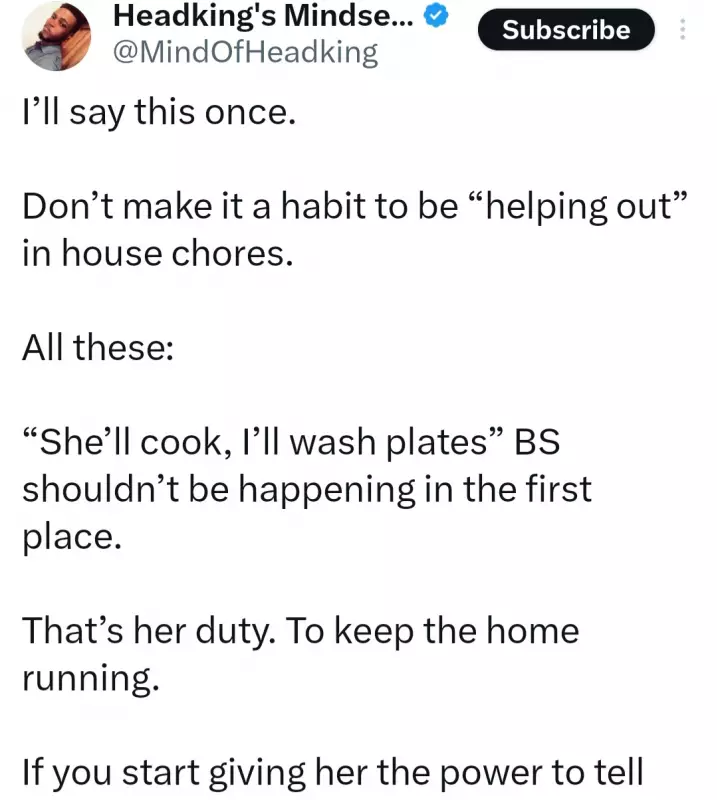
A thought-provoking social media debate about gender roles and domestic responsibilities in Nigerian marriages has captured widespread attention online.
The Controversial Advice That Sparked the Debate
The conversation began when an X user, whose identity remains undisclosed, posted advice cautioning married men. The user strongly advised men to avoid making it a habit to help with house chores, suggesting such actions could lead to disrespect from their wives. The initial poster argued that since men are typically the primary providers, the least a wife can do is manage the home front exclusively.
This perspective, reflecting a more traditional and rigid division of labor, quickly drew reactions from other users on the platform.
A Powerful Counter-Argument for Partnership
In a direct and now-viral response, another X user challenged this viewpoint head-on. He declared unequivocally that if he gets married, he will wash plates, clean, and help around the house. His reasoning was built on a foundation of mutual respect and equality.
"Because I am not marrying a slave. I am marrying a partner," he stated, framing marriage as a collaborative effort rather than a transactional arrangement. He emphasized that marriage is about teamwork, respect, and love in action, dismissing the notion that it should be a "power trip."
The most pointed part of his clapback was a critique of masculinity tied to domestic avoidance: "Any man who feels 'less masculine' for doing house chores is still mentally single." He concluded with the powerful analogy, "I'm building a home, not running a plantation."
Broader Implications for Modern Relationships
This exchange, which occurred on the platform X and was reported by Linda Ikeji's blog on January 19, 2026, highlights an ongoing cultural shift. It underscores the evolving conversations among Nigerians, particularly younger generations, about what constitutes a modern, equitable partnership.
The respondent's stance champions a model of marriage where domestic duties are shared responsibilities, not gender-prescribed tasks. It challenges deep-seated stereotypes that equate masculinity solely with provision and femininity with homemaking, advocating instead for a partnership defined by mutual support and shared effort in all aspects of home life.
This viral moment serves as a microcosm of a larger societal discussion on redefining gender roles within the context of Nigerian family structures and relationships.