A Nigerian woman's declaration about her future parenting approach has ignited a significant conversation on social media about gender roles and expectations in contemporary society.
A Mother's Pledge for a New Generation
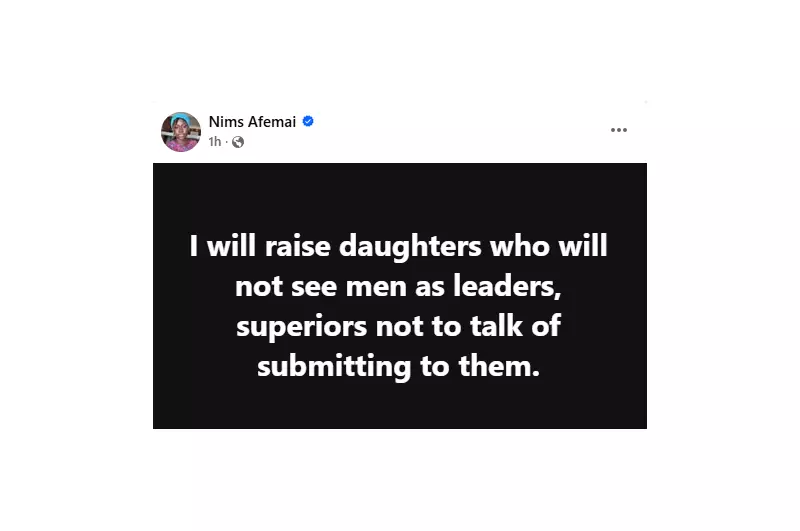
On Friday, March 1, 2026, a Facebook user named Nims Afemai made a powerful statement that quickly captured widespread attention. In a post shared at 12:54 AM, Afemai outlined her vision for raising her future children, specifically focusing on her daughters.
She declared her intention to instill in them a worldview that fundamentally challenges traditional patriarchal structures. "I will raise daughters who will not see men as leaders, superiors not to talk of submitting to them," she wrote. This concise yet provocative statement served as a clear manifesto for a parenting style rooted in modern feminist ideals.
Context and Social Media Reaction
The post, which was later highlighted by popular blogger Linda Ikeji, did not emerge in a vacuum. It comes amid ongoing national and global discussions about gender equality, women's empowerment, and the redefinition of family dynamics. Afemai's words directly confront deeply ingrained cultural norms prevalent in many Nigerian communities, where men are often traditionally viewed as the default heads of households and leaders.
Reactions to her post were predictably mixed, reflecting the diverse perspectives within Nigerian society. Many commenters, particularly women and younger generations, praised her stance as progressive and necessary for building a more equitable future. They argued that such an upbringing would foster independence, self-worth, and critical thinking in young girls.
Conversely, other social media users criticized the statement, interpreting it as promoting disrespect or sowing discord between genders. Some expressed concern that this approach might deprive children of an understanding of complementary roles within relationships and society.
Broader Implications for Nigerian Society
This incident highlights the evolving conversation around parenting in Nigeria. It underscores a growing movement among some parents who are consciously choosing to move away from rigid, traditional gender scripts when raising their children. The debate touches on core questions about identity, authority, and the values transmitted to the next generation.
While Nims Afemai's personal pledge focuses on her future daughters, the underlying principle speaks to a broader desire to cultivate a society where an individual's potential is not limited by gender stereotypes. The conversation continues to develop online, prompting individuals to examine their own beliefs and the kind of legacy they wish to create through their children.
Ultimately, this social media moment serves as a snapshot of Nigeria's cultural flux, where age-old traditions are being actively questioned and renegotiated in the digital public square.