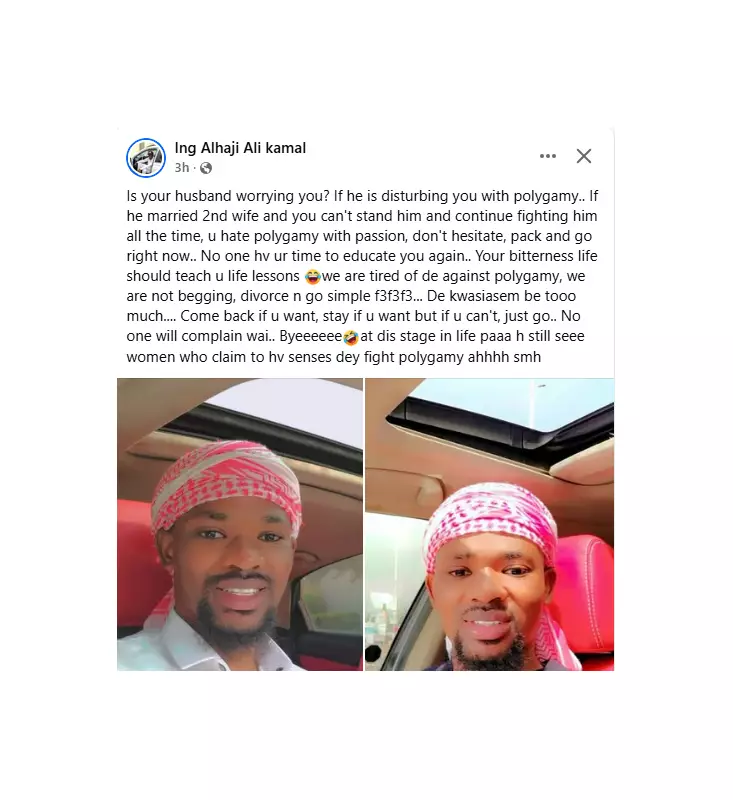
A Ghanaian man who practices polygamy has sparked a significant online debate with his blunt advice to women who oppose their husbands taking additional wives. Alhaji Ali Kamal, who is married to two women, stated that such women should either accept the situation or leave the marriage without delay.
The Viral Facebook Post
On Wednesday, December 17, 2025, Alhaji Ali Kamal took to his Facebook page to share his uncompromising views. He expressed clear frustration with women who consistently fight their husbands over the practice of polygamy. Kamal, who identifies as a polygamist himself, declared that he and others have no time to educate women who harbor a passionate hatred for polygamous unions.
In his direct post, he wrote: "Is your husband worrying you? If he is disturbing you with polygamy... If he married a 2nd wife and you can't stand him and continue fighting him all the time, you hate polygamy with passion, don't hesitate, pack and go right now." He emphasized that no one has the time to explain the dynamics of such marriages to them anymore.
A Message of Finality and Frustration
Kamal's message carried a tone of finality and exasperation. He suggested that the women's "bitterness life should teach you life lessons," adding that advocates of polygamy are tired of opposition and are not begging anyone to stay. His advice was straightforward: "divorce and go simple."
He further criticized the ongoing arguments, calling them "kwasiasem" (a Ghanaian term for nonsense or foolish talk) that has become too much. While he offered a conditional return, stating "come back if you want, stay if you want," his core message remained firm. If a woman cannot accept polygamy, she should just leave, assuring that "no one will complain." He ended his post with a dismissive "Byeeeeee," expressing disbelief that at this stage in life, women who claim to be sensible still fight against polygamy.
Reactions and Cultural Context
While the post originated from Ghana, the topic of polygamy resonates strongly across West Africa, including Nigeria, where it is legally and culturally practiced in many communities. Kamal's blunt delivery has ignited conversations about marital expectations, cultural norms, and women's autonomy within such unions.
His stance presents a polarizing view: it frames polygamy as a non-negotiable aspect for some men and places the onus of acceptance or departure solely on the first wife. The post does not address issues of consent, communication, or equitable treatment within polygamous households, which are often central to the conflicts he references.
This public declaration by Alhaji Ali Kamal highlights the ongoing and often tense dialogue between traditional marital structures and contemporary perspectives on marriage and individual choice in the region.