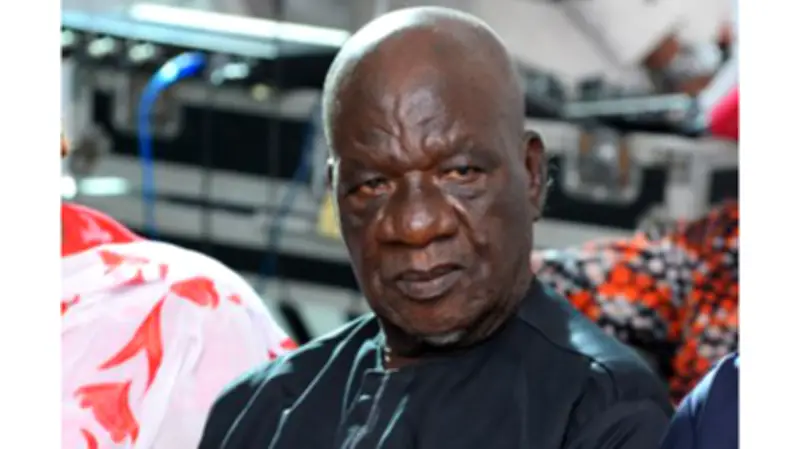
Pa Benson Idonije knows his story is not slipping away. At 90, he still has a sharp memory. His mellifluous voice, which has long fascinated fans and the media alike, remains smooth, sweet, and pleasing to the ear. When he talks jazz, his voice conveys a tone that is soft, harmonious, and easy to listen to. 'It is just arthritis that is my challenge,' he says, drawing a kind of smile. Does he still write? 'Not as much again. My eyes are paining me now, so I can't do long writing,' he explains.
Early Life and Education
Born June 13, 1936, in Otua, Owan East Council of Edo State, Idonije has had a storied career in music and broadcasting. He is best known as the first manager of Afrobeat legend Fela Kuti and played a key role in the establishment of Radio Nigeria 2 (now Metro FM) in 1977. Idonije attended Holy Trinity Grammar School, Sabongida Ora, for his secondary education and then Yaba College of Technology, where he studied communications engineering.
Career in Broadcasting
Idonije began his career in the 1950s, writing jazz columns for newspapers and joining the Nigerian Broadcasting Corporation in 1957. He became a leading voice in music commentary, presenting popular shows like The Big Beat and Stereo Jazz Club. He started presenting the Big Beat in 1968. 'The Big Beat was very popular. In fact, that was the programme that made me. Because at that time, it was a network programme. Radio Nigeria was the only station around at the time. And we had a station in Kaduna, we had one in Enugu, one in Lagos. Everybody had to tune in every Saturday afternoon. They called it the Big Beat. It was very popular. Then I had NBC Jazz Club from 1962 to 68 or 69. Then I had Stereo Jazz Club from 78 to the 90s, when I retired. From 1984 to 1992, when I retired, I became a lecturer and chief training officer at the training school at Shogunle.'
After retiring from broadcasting in 1992, he continued to write extensively about music and culture, contributing to various art-related media. From 1996 to 2016, he wrote three columns every week: Evergreen (every Wednesday), Sound and Screen (every Friday), and All That Jazz (every Sunday). 'Because I passed through a lot. I mean, it taught me what I am today, because I learned engineering, I learned broadcasting, I learned how to teach. I started as an engineering assistant, I started production, I started presenting. I became a teacher in the end, for instance, teaching elders. Of course, I was trained by the BBC on a trainee trainer's course. From 1984 to 1992, I was in the training school. I was in charge of programmes production in the training school at Shogunle. Students came from Sierra Leone, from the Gambia, and from all the stations in the country. For all that time, I had to write reports on every student, and based on that report, they were all promoted. So, I'm very happy that I've made a lot of people happy. I've impacted on a lot of people,' he reveals.
Highlife My Life and Radio Evolution
You are so much known for Highlife My Life. Was it part of the programmes that made a difference in your career trajectory at Radio Nigeria? 'Highlife My Life didn't belong to Radio Nigeria. It was a private concern for MTN. It was produced by Osaze Iyamu for MTN in Lagos.' He believes radio is not the same anymore. 'Radio Nigeria is not the same anymore.' He puts a caveat, however. 'This has to do with the dynamics of our existence. Because life has changed; life is not what it used to be at that time. And radio is out to mirror society, mirror what is happening now.' He confesses, 'I think what radio is doing now is trying to capture the essence of today's events. Because in those days, for instance, I was a teacher. As a teacher, I taught all the programme production formats. Programmes were based on formats. I mean, there were rules. They were like rules. The BBC still does it. You had the talk, you had the interview, you had the magazine, you had discussion, you had drama, you had features, you had documentary, you had variety and light entertainment. All of these programmes happened on radio, and even on television. And they had their own rules. It was the formats that we taught in training school. Because the BBC taught us how to teach them. But we find that you cannot listen to, there's no room for features and documentaries on radio anymore. You hardly hear drama on radio anymore. I'm sure you remember a drama programme like Sheki Sheki Alao. It was very popular in those days. I mean, it was like the pioneering drama programme that we had in this country, Sheki Sheki Alao. And other features, they don't exist anymore. But all that is happening today is music. You know. So, it's not the same anymore. Because times have changed.'
Influential Jazz Artistes
Jazz artistes who really impacted his life were the likes of Miles Davis, Sonny Rollins, Art Blakey, and Duke Ellington. 'As a matter of fact, it's a pity that my favourite artistes, all who had made some mark on me, sometime last week, were celebrated posthumously. Miles Davis was celebrated for being 100 years. If he were still alive, he would have been 100 years. And then Sonny Rollins died last week at 95. They were my favourite artistes.' To him, Sonny Rollins was one of the greatest tenor saxophonists, along with John Coltrane. Miles Davis on trumpet was his favourite. Also, Sonny Rollins and John Coltrane were his favourites on the tenor. Charlie Parker was his favourite on alto saxophone. 'I have all these favourites on the various instruments. I also had Wynton Kelly, Herbie Hancock as my favourites on the piano, and so on and so forth.'
On the kind of jazz that these artistes played, and the kind of jazz that people listen to now, he has this to say: 'Of course, I mean, what was happening before is more artistic, more musical than what is happening today. Because, like, for instance, listening to Miles Davis or Sonny Rollins or Clifford Brown or any of those artistes, they played along chord sequences, they improvised creatively along chord sequences. But today, you find that the artists are just repetitive. They are just dancing around the melody and all that. So, to answer your question, what the musicians did before, I mean, was more qualitative in terms of artistry than what is happening today.'
Encounter with Fela Kuti
Okay, now going to your encounter with the late Fela. What was it like? How did it shape your interest in the local music? Songs from, or musicians from Nigeria or possibly Africa? In 1963, Idonije met Fela Anikulapo-Kuti, the legendary Afrobeat pioneer, marking a significant moment in his career. Idonije was presenting a jazz programme called 'NBC Jazz Club.' Fela had listened to his programme on the radio for a month. Then, one night, he drove down to the broadcasting house in Ikoyi to see who was behind the show. He came to the studio and introduced himself. That was how they became friends. He admired his knowledge of jazz and Idonije admired his musicianship. He was a fine trumpeter. From that night, they bonded. Together, they nurtured the idea of a quintet and formed the band Koola Lobitos, initially playing jazz before switching back to highlife on Fela's mother's advice. Idonije managed the band until 1969, continuing his advisory role until the early 1970s. His management work with him was on the basis of friendship and not exactly a business deal. He had to advise him, show him the rope, and generally guide him because he was easily provoked. He worked with him from 1963 till 1974. Idonije didn't quit. Fela just didn't need a manager of his type anymore. He needed managers abroad that would link him into big shows. We were still friends till he died. 'As a matter of fact, Fela and I got to enjoy African music from 1971 when he went to America. He discovered African music in America with My Lady's Frustrations, which later transitioned to Jeun koku,' he says.
Afrobeat vs Afrobeats
He discovered African music. African music that has become world music today, Afrobeat that has become world music that everybody now plays. And music that has become his own creation. So, for somebody who has seen it all in terms of the African music, what would you say is particular about Afrobeat without the S and Afrobeats with the S? 'Yeah, the Afrobeat with the S is a commercial venture created by these artistes making waves internationally. The music has touched almost everybody in the world. Listening to Wizkid, listening to Davido, listening to Rema, Nigeria is on top right now. In the whole world, I mean, pushing Afrobeats to various boundaries and touching every heart. So, Nigerian music, Afrobeats has a great future and Nigeria is on the map right now when it comes to music. Music is generational. Music is always in motion. For instance, music started with Sakara in those early days. Then it went into Sakara, Akpala and all that. Then it went into Juju music, it went to highlife, then it went to Afrobeats. Even before Fela died, his Afrobeat transited to what he called classical African music. You know, so music was always in motion. There's no stagnation in nature when it comes to music. So, my son, Burna Boy, would not have been playing highlife today when what is in vogue is Afro, what is trending is Afrobeats. So, musicians would want to identify with what is happening now. You'd be surprised that in the future, Afrobeats may transit into something that is older. So, music is always in motion, like every other thing.'
Final Thoughts
He believes government is relevant to people's lives. So, the people should pay more attention to who governs them. 'Come out and vote in the next election,' he surmises.