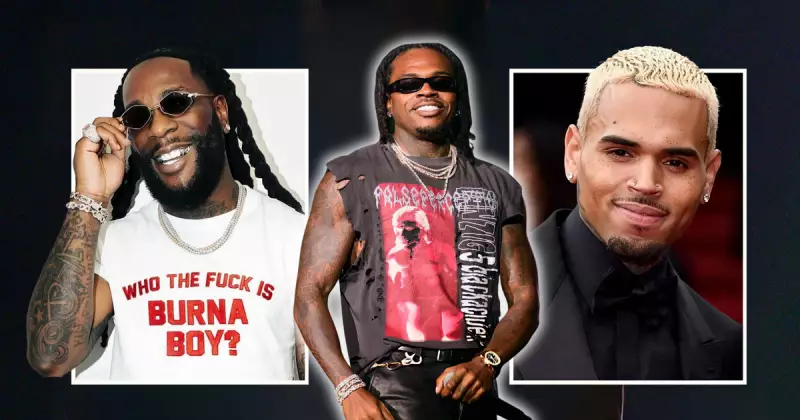
The hip-hop and global music scene is rarely quiet, and the latest uproar comes from Atlanta rapper Gunna. He has released a remix of his track 'WGFT' (Who Gon' F*ck Tonight) that has caused a significant split among fans. The reason? He has completely replaced the original feature from Nigerian superstar Burna Boy with American R&B icon Chris Brown.
The Remix That Divided the Internet
The original version of 'WGFT' was a standout track from Gunna's 2025 album, 'The Last Wun'. Featuring Burna Boy's distinctive Afro-fusion vocals over a hypnotic, echo-laden beat by producers Shottie and Turbo, the song achieved notable success. It peaked at No. 81 on the Billboard Hot 100 and enjoyed a resurgence on UK charts, partly driven by its popular music video.
The new remix, dropped on January 16, 2026, strips away Burna Boy's contribution. In his place, Chris Brown delivers a smooth, radio-friendly R&B verse. This strategic swap has ignited a fierce online debate. Some listeners hail the Chris Brown version as a more polished, commercially viable upgrade. Meanwhile, loyal Afrobeats fans and supporters of Burna Boy view the move as a slight, accusing Gunna of sidelining African talent to chase mainstream American airplay.
Remix Strategy: A Common Play for Extended Success
To understand Gunna's decision, it's crucial to see it as part of a long-established music industry playbook. A remix is not merely a tweak; it can be a complete strategic overhaul designed to breathe new life into a song, tap into a different audience, or dominate new radio formats.
History is filled with examples where feature swaps led to monumental success. Jennifer Lopez's 'I'm Real' saw a Ja Rule feature replace the original arrangement, catapulting it to No. 1 on the Hot 100. Lil Nas X's 'Old Town Road' extended its record-breaking chart run by adding Billy Ray Cyrus.
Within the Afrobeats sphere, the blueprint is clear. Wizkid's 'Essence' became a global phenomenon, but its remix with Justin Bieber was instrumental in cracking the US Top 10 and earning Grammy nominations. Similarly, Master KG's 'Jerusalema' remix featured Burna Boy, amplifying its international appeal without erasing the original's charm.
A more recent Nigerian example is Shallipopi's 'Laho' series. The original solo track was a massive hit. 'Laho II' added Burna Boy for crossover energy, while 'Laho III' removed Burna to feature Puerto Rican star Rauw Alejandro, successfully targeting Latin markets. Each version served a distinct purpose and coexisted successfully.
Data, Fan Wars, and the Bigger Picture
The fan debate often misses the practical realities of the streaming era. As of January 17, 2026, the original 'WGFT' with Burna Boy has already amassed over 130 million streams on Spotify, proving its solid foundation and appeal. The Chris Brown remix, just a day old, is showing strong early streaming numbers.
From a commercial standpoint, the swap makes strategic sense. Chris Brown possesses a proven track record of dominating U.S. R&B and pop radio formats. His collaboration with Gunna on 2019's 'Heat' was a success, and this remix aims to replicate that formula to push 'WGFT' higher on the Hot 100, potentially targeting a Top 40 position.
However, the criticism from Afrobeats purists touches on a valid cultural point. It raises questions about whether international artists treat African features as disposable once initial buzz is achieved. Yet, the counter-argument is that the original track remains untouched and widely available for fans. This remix does not delete Burna Boy's contribution from history; it simply offers an alternative version for a different market.
The core lesson is about creative freedom and market strategy. There are no fixed rules for a remix. An artist can choose to add, subtract, or completely reimagine a song. In this case, Gunna's team is executing a calculated move to extend the song's commercial lifespan and reach. The online 'war' is largely noise. In reality, both versions can thrive simultaneously—the original preserving its cultural and sonic identity, and the remix chasing broader chart success.
The ultimate winners are the listeners, who get multiple interpretations of a hit track, and the artists involved, who benefit from renewed attention and expanded reach.