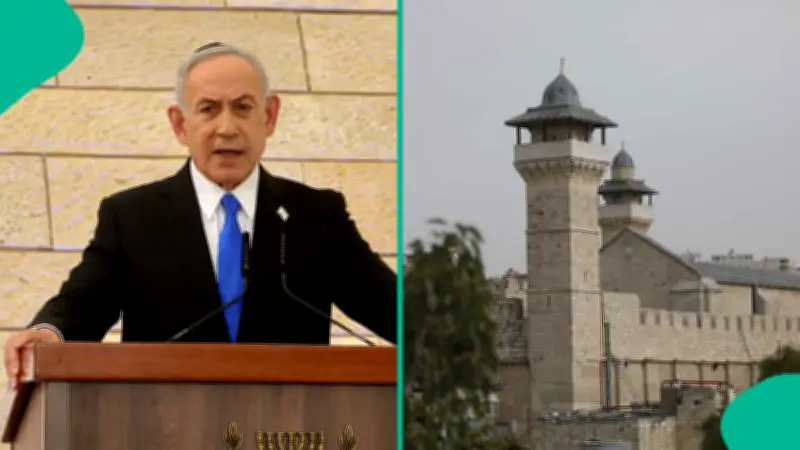
Israel has seized planning powers over the Ibrahimi Mosque in Hebron, stripping the Palestinian municipality of authority granted under the 1997 Hebron Agreement. The move, announced by Finance Minister Bezalel Smotrich, has been described by observers as “dangerous” and a direct challenge to existing arrangements in the occupied West Bank. Palestinian leaders and international bodies warn it could further inflame tensions in one of the region’s most volatile cities.
Details of the Seizure
Israel has taken over planning and construction powers for the Ibrahimi Mosque, a site sacred to Muslims, Jews, and Christians, in the occupied West Bank. Finance Minister Bezalel Smotrich announced on Tuesday that he had “abolished” parts of the 1997 Hebron Agreement, which had given the Palestinian municipal council authority over planning in the H2 zone of Hebron.
“This is a historic step to deepen Israeli sovereignty,” Smotrich said, linking the decision to wider settlement expansion policies.
What is the Ibrahimi Mosque?
The mosque, also known as the Sanctuary of Abraham, is believed to house the tombs of Abraham, Isaac, Jacob, and their wives. Jews and Christians call it the Tomb of the Patriarchs. Built in the 14th century, it has long been a flashpoint for violence, including the 1994 massacre when a settler killed 29 Muslim worshippers and injured 125 others.
Impact on the Hebron Agreement
The Hebron Agreement, signed in 1997 by Yasser Arafat and Benjamin Netanyahu, divided Hebron into two zones: 80% of the city under Palestinian control and 20% under Israeli control, including the Ibrahimi Mosque and Jewish settlements. While Israel already controlled security in H2, Palestinians retained planning powers. Smotrich’s move removes this authority, effectively sidelining Hebron’s municipality.
Observers warn this undermines the Oslo Accords, which were meant to pave the way for Palestinian self-determination. “They turned it into like the rest of Area C of the West Bank where Israelis unilaterally decide what to build, what to expand,” said Fathi Nimer of Al-Shabaka.
Palestinian and International Reaction
Palestinian President Mahmoud Abbas’s office condemned the decision as a violation of international law. Hebron’s mayor, Yousef Al-Jabari, called it a “racist decision aimed at stripping the Hebron municipality of its powers.” The Council on American-Islamic Relations described the move as “yet another attempt to consolidate illegal occupation.” Chris Doyle of the Council for Arab-British Understanding warned: “Any moves to change the existing arrangements in Hebron in favour of intensifying the Israeli occupation are extremely dangerous.”
Wider Context of Settlements
According to Al Jazeera, Israel’s settlement expansion in the West Bank has long been considered illegal under international law. More than 700,000 settlers now live on Palestinian land. Smotrich, himself a settler, has openly opposed Palestinian statehood and pushed for annexation. Similar restrictions have been seen at the Al-Aqsa Mosque, where Israeli authorities impose closures and entry bans under the guise of “security measures.”
Observers warn that tensions in Hebron are rising as Israel abolishes key provisions of the Hebron Agreement. The international community has called for restraint and adherence to existing agreements to prevent further escalation in one of the most sensitive areas of the Israeli-Palestinian conflict.