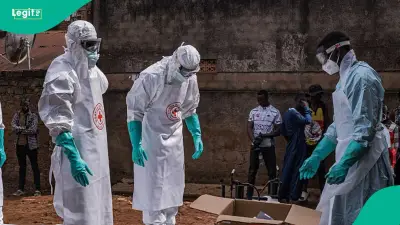
The Federal Government has placed Lagos, the Federal Capital Territory (FCT), and 19 other states on high alert over possible Ebola importation into Nigeria following renewed outbreaks in parts of Africa.
NCDC Issues Warning
The Nigeria Centre for Disease Control and Prevention (NCDC) announced the development on Thursday, warning that the growing spread of the virus in East and Central Africa has increased the risk of cross-border transmission into Nigeria.
According to the NCDC, states considered to be at high risk include Lagos, Rivers, Kano, Enugu, Borno, Akwa Ibom, Cross River, Taraba, Adamawa, and FCT.
Director-General and Chief Executive Officer of NCDC, Dr. Olajide Idris, stated that these areas were identified due to factors such as international airports, busy trade activities, porous land borders, and movement of people across neighbouring countries.
Moderate Risk States
Other states classified under moderate risk are Ogun, Nasarawa, Kaduna, Plateau, Kogi, Niger, Jigawa, Katsina, Bauchi, Ebonyi, Abia, and Bayelsa.
Speaking on the situation, Idris said Nigeria has not recorded any confirmed Ebola case linked to the current outbreak, but stressed that authorities are taking precautionary steps due to rising cases reported in the Democratic Republic of Congo (DRC) and Uganda.
“The risk of Ebola importation into Nigeria is high because of international travel, regional population movement, porous borders, and extensive trade networks,” he said.
Risk Assessment and WHO Declaration
The agency explained that the latest classification followed a new dynamic risk assessment carried out in response to the outbreak currently affecting parts of Africa. The NCDC also referenced the World Health Organisation’s decision to declare the outbreak a Public Health Emergency of International Concern, saying the development makes it necessary for Nigeria to immediately strengthen preparedness efforts across the country.
Health officials warned that Ebola symptoms can easily be mistaken for malaria or Lassa fever in the early stages, which may delay detection and increase the chances of spread if not quickly identified.
Surveillance and Preparedness
Nigeria’s porous land borders are under increased surveillance as the NCDC identifies regional population movement as a primary risk factor for transmission. According to the NCDC, health authorities in the DRC and Uganda have so far recorded 1,077 suspected Ebola cases and 247 deaths, with most infections found among people between the ages of 14 and 45.
The agency further disclosed that the ongoing outbreak involves the Bundibugyo strain of the Ebola virus, a variant for which there are currently no approved vaccines or specific treatments. Idris said this makes early detection, isolation of suspected patients, contact tracing, and proper infection prevention measures extremely important.
He also clarified that Ebola is not an airborne disease. The virus mainly spreads through direct contact with infected blood, body fluids, contaminated surfaces, or infected animals.
Directives to State Governments
The NCDC has now directed state governments to activate emergency preparedness plans, improve surveillance at airports and border communities, prepare isolation centres, and ensure frontline health workers have adequate protective equipment. States were also instructed to submit readiness reports within 72 hours and report any suspected Ebola cases, unusual fever outbreaks, or high-risk exposure incidents immediately.
Nigeria previously battled an Ebola outbreak in 2014 after an infected Liberian-American traveller arrived in Lagos. The country later successfully contained the virus through aggressive contact tracing, public awareness, and emergency public health measures, a response that gained international recognition.