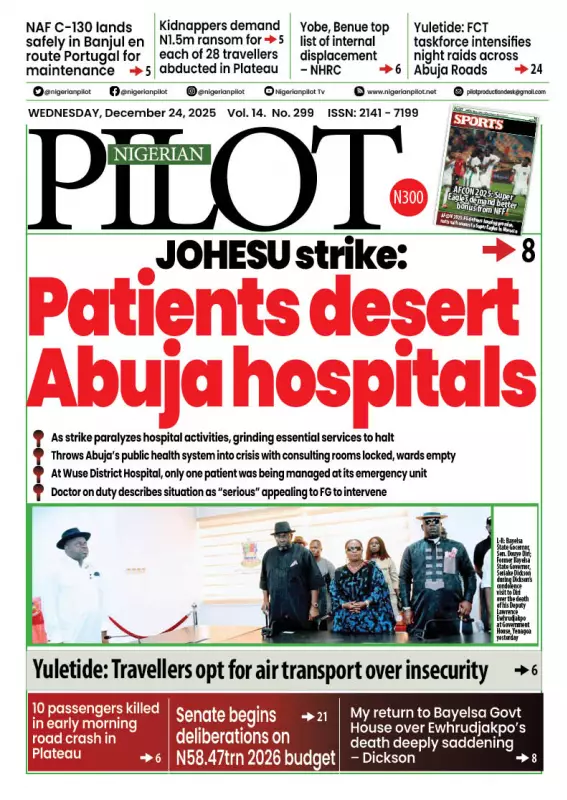
The ongoing industrial action by the Joint Health Sector Unions (JOHESU) has plunged Abuja's public healthcare delivery into a severe crisis, leaving hospitals deserted and patients stranded as essential services completely grind to a halt.
Empty Wards and Locked Consulting Rooms
A visit to major public health facilities in the Federal Capital Territory paints a grim picture of the strike's impact. At the Wuse District Hospital, consulting rooms were found locked and patient wards stood empty. The hospital's emergency unit, which typically buzzes with activity, was managing only one patient at the time of observation.
A medical doctor on duty, who spoke anonymously due to the sensitivity of the situation, described the scenario as "serious." She warned that the strike is gaining momentum as more health sector unions join the action, drastically reducing the hospital's capacity to attend to patients. This is an unprecedented development for a facility known for its heavy daily patient traffic.
Human Toll: Patients Bear the Brunt
The disruption has sparked fears among residents that health outcomes will worsen, particularly for vulnerable groups including children, the elderly, and individuals managing chronic illnesses. Relatives of patients have expressed a sense of helplessness, urgently calling on the government to find a resolution.
At the National Hospital, Collins Ajaro shared a distressing account of how his sister's gastrointestinal condition has been poorly managed due to the strike. He explained that delays and limited access to medical attention have significantly slowed her recovery, causing both physical discomfort and emotional distress. "The strike has worsened her condition and made therapy difficult," Ajaro stated, highlighting the direct human cost of the industrial dispute.
Roots of the Dispute and Mass Protest
The Joint Health Sector Unions declared the strike on November 14, 2025, following the expiration of a 15-day ultimatum issued to the Federal Government. According to JOHESU spokesperson, Comrade Martin Luther, the grievances date back to 2014 and encompass issues such as poor funding, stalled registration processes, and the non-implementation of the Consolidated Health Salary Structure (CONHESS).
As of November 17, the strike had entered its 33rd day, crippling services provided by pharmacists, laboratory scientists, and other allied health professionals across the nation. The union's resolve was further demonstrated on December 19, when its members staged a mass protest in Abuja. Thousands of workers picketed the Federal Ministry of Health and Social Welfare, demanding the resignation of the Minister, Professor Mohammed Ali Pate, if their demands remain unaddressed.
Luther described the situation as "discouraging," noting that even basic hospital operations like patient registration have collapsed. He stressed that the union never intended for the strike to be prolonged but was compelled by the government's apparent inaction. "We expected greater attention to our demands. Instead, we have been ignored," he lamented.
This industrial action has now become one of the longest in Nigeria's health sector in recent years, raising critical concerns about its impact on public health and the credibility of government negotiations. Analysts warn that unless urgent and concrete steps are taken to resolve the dispute, the crisis will deepen, endangering more lives and further eroding public trust in the country's healthcare system.