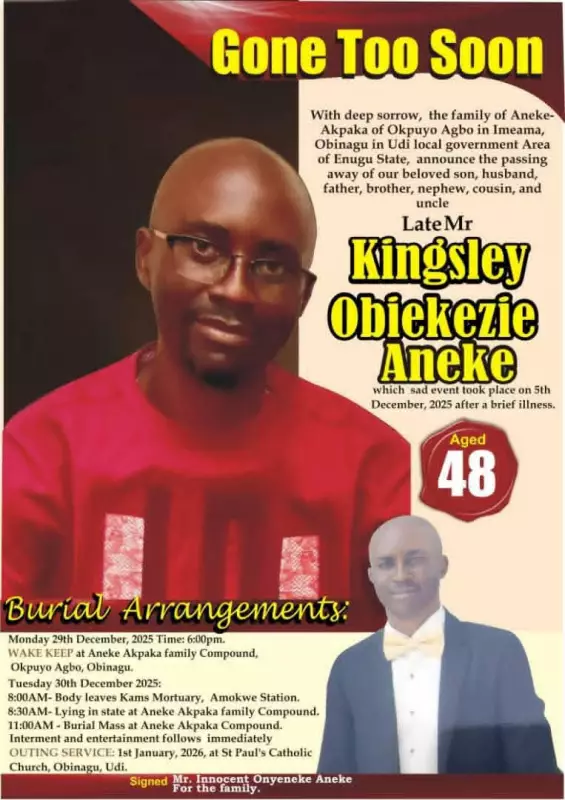
A Nigerian activist's final, powerful message, written as his own death announcement, has laid bare the catastrophic failures within the country's healthcare system. Kingsley Obiekezie Aneke, a 48-year-old man who long advocated for a better Nigeria, passed away on December 5, 2025, after a battle with a heart condition exacerbated by systemic neglect.
A Final Testament Against a Broken System
Before his demise, Aneke authored a moving obituary that was published on Facebook on December 23. In it, he stated poignantly, "I've become a victim of the system I long wished to change." He detailed his years of managing a heart condition, a struggle that grew harder when his trusted cardiologist relocated abroad due to Nigeria's challenging conditions.
His health crisis reached a peak on November 24, 2025, when he was admitted to a hospital that had previously managed his care. When his situation became critical, doctors needed to refer him to the Lagos University Teaching Hospital (LUTH) for specialized expertise. However, LUTH, like many other public hospitals, was on strike, rendering this critical lifeline inaccessible.
The Cruelty of "Payment Before Service"
Faced with a closed public system, Aneke's family sought help from private facilities. They approached Evercare Hospital in Lekki and Dukes Neurosurgery and Specialist Hospital on Victoria Island. Both institutions demanded a deposit exceeding two million naira before commencing any treatment. The family chose Dukes Hospital.
In his obituary, Aneke accused the hospital of prioritizing payment over his survival. "The hospital was more interested in their deposit of millions before they can even lay a finger on me," he wrote. "The hospital was more interested in milking my family than saving me... they kept billing until the last minute." Despite his family's sacrifices, he lost his life on December 5.
A Scathing Indictment and a Plea for Change
Aneke used his final words to directly call out individuals he accused of defending poor governance for tribal reasons, naming Olugbenga Adekunte, Akapo Jackson, Omolewa Jackson, and Awopeju. He connected his personal tragedy to the national malaise, citing daily deaths from bad governance, dilapidated roads, rampant kidnapping, and the brain drain of medical professionals.
He warned that private hospitals can be "a death trap in critical situations" due to limited experts compared to public hospitals, yet politicians remain focused on the 2027 elections instead of fixing the country. His hope was that his death would serve as a wake-up call, highlighting the harsh realities faced by millions who cannot afford any care at all.
He concluded with practical advice for friends, urging regular medical checkups, healthy living, and a positive mindset. His ultimate plea was: "Please continue the fight for a better Nigeria, not just for me, but for all who dream of a fair and just nation." His obituary stands as a heartbreaking indictment and a powerful call to action from beyond the grave.