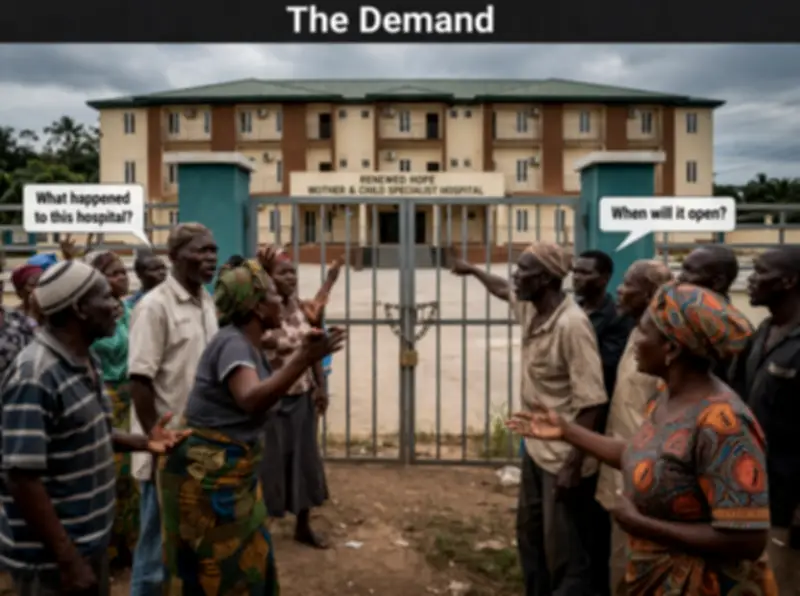
A primary healthcare centre in Akwa Ibom State, built and commissioned by the government, has remained locked and non-functional for months, leaving women and children without access to essential medical services. The facility, located in a rural community, was meant to serve as a lifeline for maternal and child health but stands idle due to lack of staffing, equipment, and utilities.
Commissioned but Never Opened
The hospital was officially commissioned in 2023 by state officials, including the Commissioner for Health, as part of a broader initiative to improve primary healthcare in underserved areas. However, an investigation by Premium Times revealed that the facility has never been opened to the public. Key services such as antenatal care, delivery, and immunization are unavailable.
According to a community leader who spoke on condition of anonymity, “We were told the hospital would start operations immediately after commissioning, but months later, the doors remain locked. Women still travel long distances to other towns for delivery, and some have died on the way.”
Lack of Staff and Basic Amenities
Inside the facility, beds remain wrapped in plastic, medical equipment is stored in unopened boxes, and the pharmacy is empty. No doctor, nurse, or midwife has been posted to the centre. The building has no running water, electricity, or internet connection, making it impossible to operate even if staff were present.
Documents obtained from the Akwa Ibom State Primary Healthcare Development Agency show that the project was funded by a grant from the World Bank under the Nigeria State Health Investment Project. The grant covered construction and equipment, but the state government was responsible for staffing and operational costs. The agency’s spokesperson, when contacted, said efforts were ongoing to resolve the issue but did not provide a timeline.
Impact on Women and Children
The lack of a functional healthcare centre has dire consequences for maternal and child health in the community. Nigeria has one of the highest maternal mortality rates in the world, with 512 deaths per 100,000 live births, according to the World Health Organization. In Akwa Ibom, many women give birth at home without skilled attendants, increasing the risk of complications.
A pregnant woman in the community, who gave her name as Ekaette, said, “My last delivery was at home because I couldn’t afford transport to the nearest hospital. I bled for hours and almost died. If this centre were open, I would have gone there.”
Government Response and Accountability
The Akwa Ibom State Commissioner for Health, Dr. Patrick Eshiet, acknowledged the situation in a phone interview but blamed the delay on bureaucratic processes. He stated, “We are aware of the challenges at the centre. We are working with the Primary Healthcare Development Agency to post staff and connect utilities. It is a matter of weeks, not months.”
However, community members remain skeptical, noting that similar promises have been made before without action. The locked hospital stands as a symbol of failed promises, highlighting the gap between policy and implementation in Nigeria’s healthcare system.
Broader Context of Healthcare Failures
This case is not isolated. Across Nigeria, many primary healthcare centres lack basic amenities, staff, and drugs. A 2023 report by the National Primary Healthcare Development Agency found that only 20% of primary healthcare centres in the country are fully functional. The rest suffer from infrastructure deficits, underfunding, and poor management.
In Akwa Ibom, the state government has built several new health facilities in recent years, but many remain unopened or underutilized. The locked hospital is a stark reminder that building infrastructure is only the first step; ensuring it serves the community requires sustained investment and accountability.