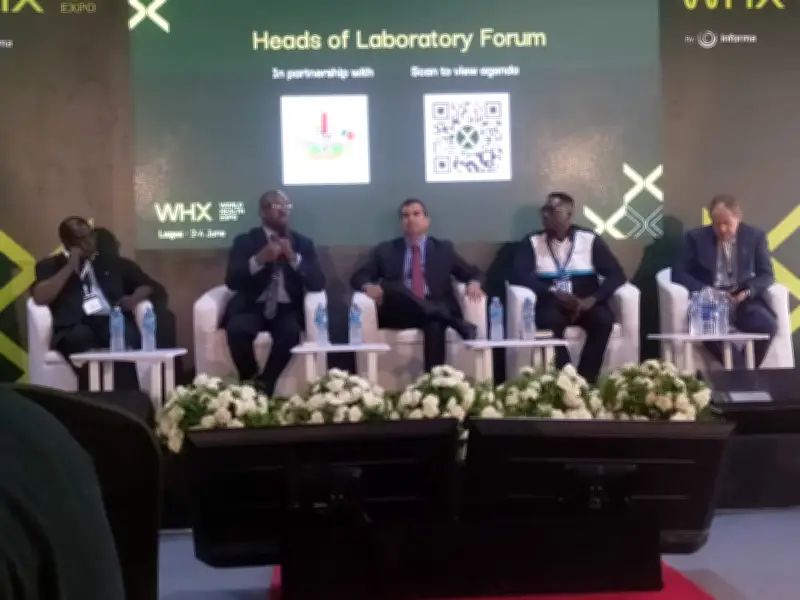
As the final conversations wound down at the Landmark Centre in Lagos and delegates exchanged last handshakes before departing, a defining message emerged from WHX Lagos 2026: Africa’s healthcare future will not be determined by innovation alone, but by its ability to finance, scale and deliver those innovations to the people who need them most.
For three days, healthcare leaders, policymakers, researchers, diagnostic companies, technology providers, investors and development partners gathered under the theme, “Transforming Diagnostics: Investment, Innovation and Strategic Partnerships.” While discussions showcased cutting-edge technologies and emerging healthcare solutions, the event consistently returned to a more fundamental challenge — how to ensure that advancements in diagnostics translate into accessible, affordable and equitable healthcare for millions of Nigerians and Africans.
Public-Private Partnerships as a Key Solution
The conversation gained particular momentum during a keynote session on “Public-Private Partnerships (PPP): Funding the Future of Diagnostics,” delivered by Professor Oluyemi Akinloye, Director of the Centre for Genomics of Non-Communicable Diseases and Personalised Healthcare at the University of Lagos. His presentation framed what would become one of the central themes of the event: healthcare transformation requires not only scientific progress, but also collaboration, coordination and sustainable financing.
“When you look at healthcare in Nigeria, Africa and indeed globally, what we need is accessible quality healthcare that serves everyone — the rich, the poor and the average citizen,” he said. According to Akinloye, the world is currently witnessing a rapid transition in healthcare diagnostics. Technologies that once existed only within research laboratories are increasingly becoming practical tools capable of transforming disease detection, treatment and prevention. Yet, the challenge, he argued, lies in ensuring that these innovations move beyond academic institutions and become available to ordinary citizens.
“We need huge global investments and a lot of innovations that are already leaving the research space to become services available for everybody,” he noted. For him, the future of diagnostics depends on building bridges between governments, universities, research institutions, healthcare providers, technology companies and investors.
The era when governments could single-handedly drive healthcare transformation is long gone, he argued. “It is not possible, except we want to deceive ourselves, that governments will do everything,” he said. “Governments have many responsibilities and competing priorities. The private sector must play a significant role — not only in making profits, but also in creating meaningful social impact.”
His remarks reflected a growing consensus among stakeholders that healthcare delivery in developing countries requires a more integrated approach, particularly in diagnostics, where infrastructure costs, technological requirements and workforce development demand substantial investment. Akinloye pointed to successful public-private partnership models around the world. These include infrastructure partnerships within the United Kingdom’s National Health Service (NHS), diagnostics-focused collaborations across countries such as Ethiopia, Ghana and Kenya, and global alliances involving governments, diagnostic manufacturers and development agencies in tackling diseases like tuberculosis and COVID-19. Such partnerships, he said, demonstrate that effective healthcare systems are built through cooperation rather than isolated efforts.
The professor also highlighted the need for sustained investment in human capital, noting that sophisticated diagnostic technologies are only as effective as the professionals trained to deploy and interpret them. “Diagnostics has evolved from mere observation and microscopic techniques to highly sophisticated innovations backed by technology,” he explained. “There must be deliberate development of human resources supported by substantial funding.”
Underlying his message was a broader concern about healthcare inequality. While advanced economies continue to benefit from emerging technologies and precision medicine, many developing countries remain unable to fully leverage similar innovations because of fragmented systems and inadequate coordination between key stakeholders. “If other countries are treating difficult diseases through technology and innovation, we should not be left behind because our systems are not organised or synchronised,” he said.
Healthcare Financing: A Major Barrier to Access
The question of access remained central throughout the event, particularly during discussions with industry leaders responsible for delivering healthcare services on the ground. Chief Executive Officer of Synlab Nigeria, Kenneth Okolie, described healthcare financing as one of the most significant barriers preventing wider access to diagnostics and quality care in Nigeria. According to him, demand for healthcare services is not the problem. The real challenge lies in how those services are funded.
“There is clearly no problem with demand,” he said. “The challenge is that healthcare is mostly out-of-pocket in Nigeria.” For millions of Nigerians, healthcare decisions are often shaped by immediate economic realities. Before seeking medical attention or diagnostic testing, many households must first weigh competing financial obligations such as food, housing, transportation and education. “Before the average individual spends on healthcare, he first asks himself: Have I eaten? Have I paid my rent? Have I done this? Have I done that?” Okolie observed.
This dynamic creates a cycle that affects both patients and providers. When individuals cannot afford healthcare, demand becomes constrained despite significant health needs. In turn, providers face difficulties expanding services, investing in infrastructure and reaching underserved communities. To address this challenge, Okolie emphasised the importance of strengthening health insurance systems and developing innovative financing models capable of reducing direct out-of-pocket spending. He acknowledged ongoing efforts by healthcare stakeholders to expand insurance coverage and improve healthcare financing mechanisms, but stressed that more collaboration is needed.
“At the end of the day, we need to find ways that tests can be paid for so that people can access care without having to think about where the money is going to come from,” he said. His comments reinforced one of the strongest messages emerging from WHX Lagos 2026: healthcare access is inseparable from healthcare financing. Even the most advanced diagnostic technologies will have limited impact if they remain financially inaccessible to large segments of the population.
The Role of Data and Personalised Medicine
The future of diagnostics was also examined through the lens of data, digital health and personalised medicine. Speaking on emerging trends in healthcare delivery, Dimitrios Giantzoudis highlighted the importance of building cost-effective and sustainable diagnostic systems while simultaneously investing in healthcare data infrastructure. According to him, diagnostics should not be viewed as isolated test results, but as part of a broader continuum of patient care. Medical records and longitudinal patient data, he argued, are becoming increasingly important as healthcare systems transition towards personalised medicine.
“In vitro diagnostics are not just one number,” he said. “Sometimes it is very important to know what the difference is between today’s result and tomorrow’s result.” His remarks reflected a growing global shift toward precision healthcare, where treatment decisions are informed by a patient’s unique biological characteristics, medical history and diagnostic profile. As healthcare systems generate increasing amounts of diagnostic information, the ability to track, analyse and apply that information effectively will become a defining feature of future healthcare delivery.
The concept of personalised diagnostics featured prominently throughout discussions at WHX Lagos, particularly as advances in genomics, artificial intelligence and digital health continue to reshape the healthcare landscape. Across exhibition halls, technology demonstrations and networking sessions, participants repeatedly returned to a common conclusion: the healthcare sector is no longer constrained by a shortage of innovation. Indeed, many of the technologies required to transform disease detection, improve treatment outcomes and strengthen healthcare systems already exist.
A Call to Action for Collaborative Healthcare Transformation
The challenge now is ensuring that those technologies reach patients in a sustainable, affordable and equitable manner. This requires more than technological breakthroughs. It demands strategic partnerships, policy reforms, investment in infrastructure, workforce development, stronger insurance systems and effective collaboration between public and private stakeholders. As WHX Lagos 2026 came to a close, there was a shared recognition that diagnostics occupies a critical place in the future of healthcare. Accurate and timely diagnosis influences nearly every aspect of medical care, from disease prevention and treatment to public health surveillance and health system planning.
For participants, the event served not only as a showcase of innovation, but also as a call to action. The future of healthcare in Nigeria and across Africa will ultimately depend on how successfully stakeholders can align investment, innovation and partnerships around a common goal: ensuring that quality diagnostics and healthcare services are accessible to every citizen, regardless of income, geography or social status. If there was one defining takeaway from WHX Lagos 2026, it was that the next chapter of healthcare transformation will not be written solely in research laboratories or boardrooms. It will be written in the ability of governments, industry leaders, researchers and healthcare providers to work together to ensure that innovation reaches the people whose lives depend on it.