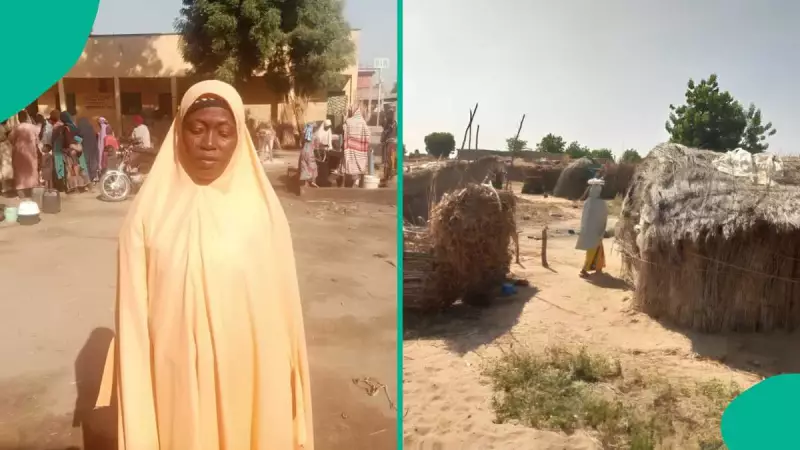
Under a sliver of shade at an informal camp in Sokoto State, Fatima Abdullahi, 36, clutches her child, a desperate shield against the relentless afternoon sun. Her memory of July 16, 2025, is a scar: her body temperature spiked until she gasped for air and collapsed, waking to a circle of women fanning her with exhausted hands. Her story, told with long, tear-suppressing pauses, encapsulates a silent emergency unfolding in Nigeria's displacement camps.
"It Feels Like My Body is on Fire": Life in Overcrowded Camps
Fatima is one of thousands who fled to Sabon Birni, a town bordering Niger Republic, as armed violence surged across northwest Nigeria. With no formal resettlement plan, families occupy public schools, motor parks, and abandoned buildings. Fatima's home for five years has been a classroom in Magaji Dawaki Primary School, a space never meant for human habitation.
"I have never been used to heat. I can hardly breathe when the heat is too much," Fatima explained. "I feel the intensity of the heat so much during the day here. It feels like my body is on fire. Sometimes the weather can be so hot it feels as though I am being squeezed into a tight place."
The suffering extends beyond the heat. Over fifty people often share a single room, forcing families to separate. "My husband is in a different place, some of the kids are also in a separate place while myself and some of the kids are here," Fatima said, describing the fragmentation of family life. Residents live in constant fear of attacks from armed groups, with Sabon Birni being one of at least seven areas in Sokoto under frequent assault.
A Climate Hotspot: Sokoto's Rising Temperatures
The anguish in the camps is magnified by a rapidly warming climate. Sokoto is naturally hot and dry, with average daytime temperatures frequently above 40°C. However, data from the Nigerian Meteorological Agency (NiMet) reveals an alarming acceleration. While Nigeria's average annual temperature rose by about 1.2°C over the past century, it has jumped nearly 1.4°C since the early 2000s alone.
Where extreme heat was rare in the 1980s, the 2020s now bring multiple severe heatwaves yearly. In 2024, Sokoto, alongside Maiduguri and Yola, recorded temperatures exceeding 47°C, some of the highest ever in Nigeria. The Federal Ministry of Health reported a 20% year-on-year increase in heat-related cases in 2023, which surged to 30% in 2024, with over 2,000 deaths attributed to extreme heat.
This climate stress triggers a vicious cycle. As Nigerians seek relief with cooling systems, electricity demand overwhelms the grid. The Nigerian Electricity Regulatory Commission (NERC) noted a 25% demand spike during the 2023 heatwave and a 30% jump in 2024, leading to more frequent blackouts.
Double Burden: Heat, Pregnancy, and Cultural Constraints
For pregnant women like Baraka Shuaibu, 29, the heat is a daily battle. "I cool myself with water. On some days, I bathe like five times a day," she said. Yet, relief is scarce. The bathrooms are exposed and shared, forcing long waits. Cultural norms add another layer of hardship. "A woman cannot expose her body to receive fresh air. She has to be covered since we are not at home, hence no privacy but a man can be on shorts," Baraka explained.
This combination of overcrowding, lack of privacy, and searing heat creates a dangerous environment for maternal health. Umma Murtala, 27, described her unborn baby's distress through frequent, unusual kicks. "I don’t feel relaxed due to the pregnancy and the heat makes it worse," she said.
Medical experts underscore the severe risks. Dr. Wodudat Muhammed, a physician in Nigeria, stated, "Extreme heat is a serious threat because the body is already working overtime." A pregnant body's increased effort to support a baby hampers its ability to cool down. Dehydration can cripple natural cooling, turning a hot day into a life-threatening emergency for both mother and child.
Research supports these concerns. Epidemiological studies link heat exposure to adverse pregnancy outcomes like stillbirth and low birth weight. Heat in the first trimester may contribute to congenital defects, while exposure later can cause premature birth.
An Urgent Call for Climate-Resilient Interventions
Assessments of five informal camps in Sabon Birni confirm these harrowing accounts. Women and children show visible signs of exhaustion, spending afternoons and nights in silent discomfort. Basira Salihu, 29, a mother of three, highlighted the gendered nature of the suffering: "We feel the heat more as women because we cannot take off our clothing in public unlike a man."
Climate expert Barakat Momoh argues for immediate, targeted action. "Moving these families into well-built, climate-resilient homes is absolutely essential," he said. He also recommended reducing overcrowding, providing battery-powered fans, and planting trees for natural shade.
The displaced women's pleas are simple yet profound. They ask for better ventilation, privacy, and a semblance of dignity. "A better place for us to stay is very important to curb the effect of the heat," said Aisha Salisu, 24. For now, they rely on makeshift solutions—strolling to cooler spots, using hand fans, and constant bathing—that offer little reprieve from a heat that has become as relentless as the conflict that displaced them.
This story was produced with support from Climate Resilience for All.