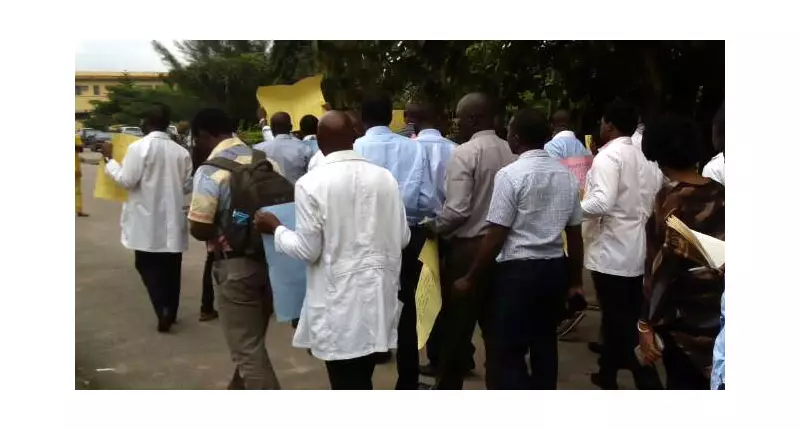
The Nigerian healthcare sector is bracing for another major disruption as the National Association of Resident Doctors (NARD) has ordered an indefinite nationwide withdrawal of services. The industrial action is scheduled to commence at midnight on Monday, January 12, 2026.
Breakdown of Negotiations and Strike Declaration
Dr. Mohammad Usman Suleiman, the President of NARD, announced the decision following an emergency meeting of the association's Extraordinary National Executive Council (E-NEC) on Friday, January 2. The council reviewed the implementation status of a Memorandum of Understanding (MoU) signed with the Federal Ministry of Health and Social Welfare and the Federal Ministry of Labour and Employment.
The MoU was meant to address nineteen critical demands concerning welfare, remuneration, and professional practice for resident doctors across Nigeria. Dr. Suleiman stated that the strike, which was previously suspended, would resume because the government had failed to demonstrate a clear, concrete, and genuine commitment to fulfilling the agreed terms.
A specific point of contention is the case of five disengaged resident doctors from the Federal Teaching Hospital (FTH) in Lokoja. NARD has rejected the Federal Ministry of Health's decision to redeploy them to another hospital. The association is demanding their immediate and unconditional reinstatement at FTH Lokoja, in line with a duly constituted committee's recommendations.
Federal Government's Response and Policy Defence
In a swift reaction, the Federal Government, through the Minister of State for Health and Social Welfare, Dr. Iziaq Adekunle Salako, denied allegations of neglect. Appearing on the AIT Kaakaki programme, Dr. Salako attributed the standoff to structural and policy issues rather than a lack of commitment.
The minister highlighted the government's approval in November 2025 of an upward review of professional allowances for health workers. This increase, covering call duty, shift duty, non-clinical duty, and rural posting allowances, adds nearly N90 billion to government expenditure annually. He presented this as evidence of the Tinubu administration's dedication to industrial harmony.
Dr. Salako explained that to prevent fragmented negotiations, his ministry adopted a collective bargaining approach. This ensured doctors, nurses, laboratory scientists, and other health workers negotiated together, unlike in the past when separate talks led to conflicting agreements.
Outstanding Issues and Contradictory Claims
There is a clear disagreement on the progress of talks. While the minister claimed NARD's demands had been reduced from 19 to nine, indicating headway, the doctors' association disputed this. NARD clarified that it had compressed its demands into nine items in a press release for public understanding, but a detailed examination revealed the issues still numbered sixteen items.
On specific demands, Dr. Salako cited policy constraints. He noted that the demand for a specialist allowance for resident doctors could not be met because current regulations reserve such allowances for consultants. The National Salaries, Incomes and Wages Commission advised against extending it, warning it could trigger similar claims from other health workers in training.
The minister also addressed certification issues, stating that the policy of the National Postgraduate Medical College, which does not issue certificates after Part I examinations, is something the ministry cannot override.
With the strike set to begin, all resident doctors in 91 tertiary health institutions nationwide are to withdraw services indefinitely. This action threatens to paralyse an already strained public healthcare system, leaving millions of Nigerians in a precarious situation as both sides remain entrenched in their positions.