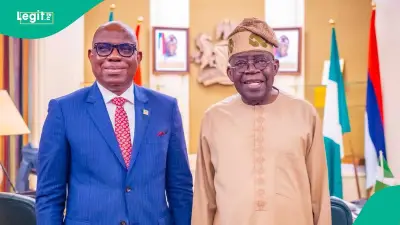
Meeting him for the first time, one is struck not only by his calm and composed presence but also by the steady assurance of experience he brings, marked by discipline, clarity of thought, and an unshakable sense of responsibility in complex governance spaces. This combination gives Mr. Biodun Dabiri a strong and respected presence in Nigeria's infrastructure and investment landscape. As Chairman of Lekki Port LFTZ Enterprise Limited, he represents a class of leadership rooted in investment banking expertise, boardroom governance, and institutional development, bringing structure and direction to large-scale economic infrastructure initiatives that continue to shape Nigeria's long-term development trajectory.
A career spanning investment banking, corporate leadership, and national infrastructure development reflects a consistent adherence to firm principles, where decisions are guided by discipline, accountability, and a clear sense of national purpose. Mr. Dabiri has distinguished himself beyond formal titles, emerging as a shaping force whose standards and commitment to integrity have influenced institutions, strengthened professionals, and supported projects with lasting national impact.
On the Meaning of Merit
On the meaning of merit, which he regards as one of the most foundational and most frequently misapplied concepts in institutional life, the erudite professional, Dabiri is characteristically precise and unsparing, insisting that merit cannot be credibly determined in the absence of objectively defined standards and that before appointments, promotions, or rewards are considered, any institution serious about excellence must first establish with clarity and discipline what success in a given role actually requires. Merit, he affirms with the conviction of a man who has spent decades watching institutions rise and fall on this very question, demands the moral courage to measure individuals against evidence-based benchmarks rather than subjective preference, familiarity, or personal loyalty, because few forces weaken institutions as surely and as silently as the gradual normalisation of comfort over competence. “A genuine culture of merit ultimately cultivates a culture of trust, which remains one of the most enduring competitive advantages any institution can possess.” He noted.
Leadership Philosophy
His leadership philosophy, built on four non-negotiable pillars of clarity of mandate, identification and recognition of key performers, fairness as strategy rather than sentiment, and astute stakeholder engagement conducted with patience and cultural intelligence, reflects the seasoned thinking of a leader who has led across the board of investment banks and the chairmanship of national infrastructure projects with equal distinction and equal adherence to the same foundational standards. He is emphatic that every engagement begins with an unambiguous statement of purpose and measurable outcomes, because without that precision, accountability becomes impossible and performance management degrades into an exercise in subjectivity. He is equally emphatic that institutions rise and fall on the energy and commitment of a relatively small number of exceptional people, and that leaders who fail to identify, nurture, and appropriately reward those individuals do so at their institution's peril, a lesson he has applied with discipline and with demonstrable results across every leadership role he has occupied.
Vision for Lekki Port
As Chairman of Lekki Port LFTZ Enterprise Limited, Dabiri has pursued a vision that extends far beyond the management of a logistics asset and encompasses the entire port and marine economy ecosystem, including ship repair facilities, cold chain logistics, bunkering services, light manufacturing, marine insurance, freight forwarding, and the full range of professional services that cluster naturally around a functioning deep-sea port of international standard. His appointment as Chairman of Lekki Port was preceded by his appointment as Chairman of the Lekki Free Zone by Governor Ambode, a role through which he quickly recognised that positioning the Free Zone as a credible vehicle for boosting Nigeria's industrial growth would require the urgent development of a deep-sea port capable of signalling to the global investment community that Nigeria could honour complex, multi-party commitments and deliver infrastructure that meets the most demanding international standards. “I want Lekki Port to be remembered not merely as a gateway for cargo, but as the anchor point for a new generation of Nigerian industrial and commercial enterprise.” he stated.
Overcoming Challenges
What followed was no less demanding. Flying eighty engineers and technicians from China to the construction site at a time when most of the world's airspace was closed required round-the-clock coordination between the project implementation team and the Nigerian Ministers of Foreign Affairs, Aviation, and Health, the Presidency, the Governor of Lagos State, and their counterparts across every jurisdiction along the only viable flight path, with the team at one point marooned in Kenya while a special charter flight was arranged and authorised. Once on site, the engineers were quarantined, accommodated, and medically monitored within the project perimeter and set immediately to work, a discipline that, as Dabiri notes may well have contributed positively to the project's remarkable cost and schedule performance. The port was delivered within three years and through a global pandemic, a testament, he affirms, to the power of principled, patient, and rigorous stakeholder engagement conducted with determination and unfailing consistency. He also acknowledges with genuine gratitude the immense contributions of now President Bola Ahmed Tinubu, who though not in office at the time threw his weight and unrelenting effort behind untying every obstacle in the project's path, and the Oba of Lagos, Oba Rilwan Akiolu, whose force and influence proved equally significant in making the project a reality.
Integrity and Accountability
On the subject of integrity and accountability, which he regards as the invisible architecture of every consequential decision he has made across a career spent in close proximity to transactions that at today's valuations would be measured in trillions, Dabiri is both deeply serious and deliberately circumspect, speaking not with the ease of a man who has never been tested but with the quiet confidence of one who has been tested repeatedly and has emerged each time with conscience intact and reputation uncompromised. He draws a distinction, sharp and important, between the dramatic moral confrontations that announce themselves as integrity tests and the far more dangerous sequence of small accommodations, each of which seems reasonable in isolation and each of which nudges one incrementally further from one's standards, noting with the authority of long experience that the discipline of integrity lies precisely in recognising that first small step for what it is and declining to take it. “Integrity maintained selectively,” he affirms without equivocation, “is not integrity at all, but tactical manipulation.”
Legacy at Lekki Port
The legacy Dabiri is most deliberately building at Lekki Port LFTZ Enterprise Limited is captured in three words he regards as indivisible and equally essential: professionalism, openness, and collaborative spirit. Professionalism means that every process and every decision conducted under the organisation's name must be of a calibre that would withstand the scrutiny of the most demanding international investor, regulator, or auditor, because in a competitive global environment for infrastructure investment, institutional quality is not a soft asset but a hard one, and he harbours the deeply held aspiration of witnessing Lekki Port listed on international exchanges as the biggest port in Africa within the next decade. Openness means a commitment to transparency with all stakeholders that goes well beyond the minimum required by law or contract. And collaborative spirit reflects the reality that a project of this complexity and national significance cannot succeed through unilateral will alone but requires the genuine alignment of a remarkably diverse coalition of interests sustained through mutual respect, honest communication, and shared ownership of outcomes.
Mentorship and Legacy
Among the achievements he holds in equal regard to any transaction or infrastructure project is the legacy of professionals he has mentored across decades of investment banking leadership, men and women who today lead banks, shape financial policy at the highest national and international levels, and serve on significant boards, carrying with them the values, the standards, and the character that were formed in part through his guidance and example. It is a legacy that speaks directly to his conviction that true leadership is ultimately measured not by the monuments one builds but by the people one shapes and the values one leaves embedded in institutions long after one's active involvement has concluded.
Advice to Young Nigerians
To young Nigerians aspiring to build careers anchored on merit and character, the distinguished Biodun Dabiri counseled that learning and toiling must precede earning, and that sequence must be protected with real determination against the enormous social pressure to reverse it. Commit first to acquiring genuine competence, to earning a reputation for integrity in every small assignment as much as in the large ones, and to embracing the discipline of lifelong learning with the full understanding that fortune, in the long run, favours not merely the brave but the hardworking, the patient, and the principled. At the same time, guard your character with even greater rigour than you would guard your most valuable financial asset, because financial capital can be rebuilt after a loss, but a reputation for integrity, once genuinely forfeited, is among the hardest of all things to recover.