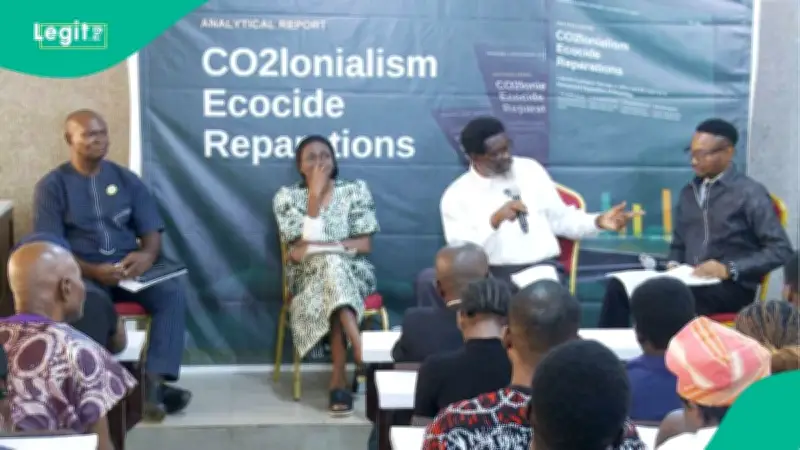
A new report launched at the University of Lagos argues that environmental destruction caused by British colonial rule in Africa could justify a separate reparations claim worth hundreds of trillions of dollars, adding a fresh dimension to the long-running debate over colonial accountability.
The report, titled CO2lonialism, Ecocide and Reparations, examines how colonial policies of land appropriation, natural resource extraction, and energy exploitation left lasting ecological damage across former African colonies. Its central argument is that this environmental harm deserves the same rigorous historical, scientific, and financial scrutiny as other recognised categories of colonial injury.
Report Highlights Scale of Colonial Resource Extraction
Lead author Professor J. G. Nkem Onyekpe told the launch audience that current reparations frameworks have largely overlooked the environmental dimension of colonial extraction. He pointed to a peer-reviewed 2022 study that placed the value of resources taken from the Global South through structurally unequal trade at more than $10 trillion for the year 2015 alone.
Applying a comparable methodology across the full span of colonial rule and all affected African states, he said, could produce a total running into the hundreds of trillions of dollars. This figure, he argued, reflects not just the value of extracted resources but also the long-term ecological costs of deforestation, soil degradation, and pollution.
Professor Nnagugwu Oscar Uluocha, Professor of Geography at the University of Lagos, described the ecological damage inflicted on Nigeria during British colonial rule as "colossal." He called for scientific evidence and environmental analysis to be used in examining the consequences of colonial land-use, agricultural, and resource-extraction policies.
Legal Precedent Cited for Ecological Reparations Claims
On the legal front, Dr Asikia Karibi-Whyte, a jurisprudence and international law expert who also spoke at the launch, challenged the widely held view that current governments bear no responsibility for wrongdoing committed by their predecessors. She argued that the United Kingdom is recognised in law as a continuing state entity, meaning changes in government or political leadership do not sever its legal continuity.
Dr Karibi-Whyte drew attention to the case Nauru brought before the International Court of Justice against its former colonial administrator over environmental devastation caused by colonial-era phosphate mining. She described it as a significant precedent for African states considering similar claims.
Growing International Focus on Ecocide
The report also highlights the growing international conversation around ecocide as a crime, alongside the African Union's move to examine whether the mass destruction of ecosystems should be classified as a criminal offence. The authors argue that these developments create an opening for an African-led framework on ecological reparations, one that places environmental repair at the centre of the broader campaign for colonial accountability.
The report's launch at the University of Lagos signals a push to integrate environmental harm into the mainstream reparations discourse, potentially influencing future negotiations and legal strategies across the continent.